

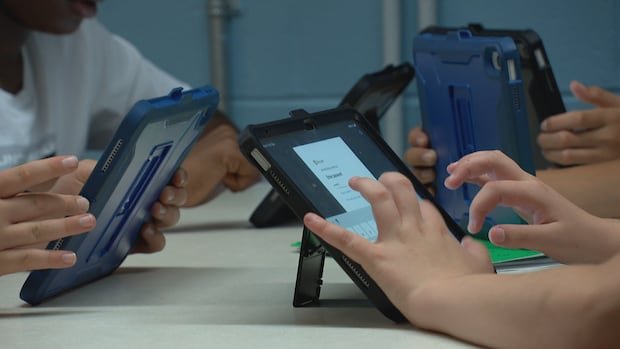

In a middle school in Moncton this week, students engaged in an interactive virtual challenge to escape from a dragon while learning about cybersecurity. Some students then proceeded to create visual presentations, while others interacted with colorful screens for a food-themed unit. Additionally, a few students were involved in programming small robots. The activities incorporated artificial intelligence tools as Grade 7 students were supervised by their teacher.
The Anglophone East School District has been exploring the integration of AI into classrooms for the past few years. Following the Department of Education’s update to the anglophone K-12 curriculum, more schools in New Brunswick are adopting AI education. This move contrasts with recent international trends like Norway, which banned generative AI use in schools up to Grade 7, and major U.S. school boards restricting student access to AI.
As the debate continues on the appropriate use of AI in education, New Brunswick’s curriculum now includes structured AI learning. This approach is seen as a crucial initial step that other provinces are encouraged to follow. The objective is to introduce AI thoughtfully, guiding students to critically assess the technology. In New Brunswick, students from kindergarten to Grade 2 begin with basic digital literacy discussions, progressively advancing to practical applications on digital devices, although primary students do not engage with chatbots.
Educators receive training on integrating AI tools responsibly, ensuring compliance with age restrictions and prioritizing students’ critical thinking skills. The curriculum includes approved platforms like Copilot, Canva, Suno, and Gemini Notebook, emphasizing AI as a supportive tool rather than a shortcut. Teachers undergo professional development and are supported by tech coaches, with the province offering AI learning modules for educators.
New Brunswick’s curriculum emphasizes safe and ethical AI use, promoting AI literacy in schools. Education Minister Claire Johnson emphasized the importance of AI integration while upholding fundamental literacy and numeracy skills and the necessity of teacher judgment in the learning process.
The discussion around AI in schools has sparked concerns among parents, with some urging caution and emphasizing the need for oversight and proper training for educators. The rapid advancement of AI technology raises questions about its impact on learning and student development, prompting calls for a more deliberate approach to AI integration in classrooms.
A recent survey highlighted a significant gap between student and educator AI use, underscoring the need for clearer policies and guidance in AI education. Experts suggest that education ministries should collaborate and draw on international best practices to address challenges related to AI implementation effectively. This shift towards AI integration reflects a broader systemic change in education, requiring a comprehensive and coordinated approach at the national level.