



Last year, when Ursula von der Leyen, the President of the European Commission, joined Donald Trump at his Turnberry golf resort in Scotland, she assured Europeans that agreeing to a blanket 15 percent tariff on EU exports would provide the continent with “predictability and stability.”
However, some critics now interpret the trade agreement as a lopsided concession that has instead set the stage for a continual cycle of economic pressure from the United States.
Initially, the U.S. sought to reclassify certain European industrial products in order to impose higher tariffs. Now, a new conflict has surfaced concerning European attempts to implement a digital services tax on American tech giants—a dispute reminiscent of Washington’s recent efforts to dictate tax conditions to Canada.
Barely had the Turnberry agreement been ratified by the European Parliament when Trump took to Truth Social, threatening to nullify the entire agreement by imposing 100 percent tariffs on any European country that introduces or expands tech taxes.
As European opposition to Trump’s demands strengthens, some legislators are viewing Mark Carney’s abrupt departure from U.S. trade discussions not as a reckless decision, but as a valuable lesson in confronting a bully.
Former French ambassador to the U.S., Gerard Araud, posted that “Canada should lead the way for the EU: with Trump, only firmness is effective.”
“Nations that uphold democracy and the rule of law—and refuse to accept the law of the jungle—must collaborate,” wrote Bernd Lange, a German MEP and chair of the EU’s trade committee, on X. “We are aligned with Canada.”
Additionally, former Swedish Prime Minister Carl Bildt remarked:
“With Canada, China, and Brazil demonstrating that it is possible to confront the United States in trade discussions, I suspect there will be discreet conversations in the EU and Japan about whether they made the right decision.”
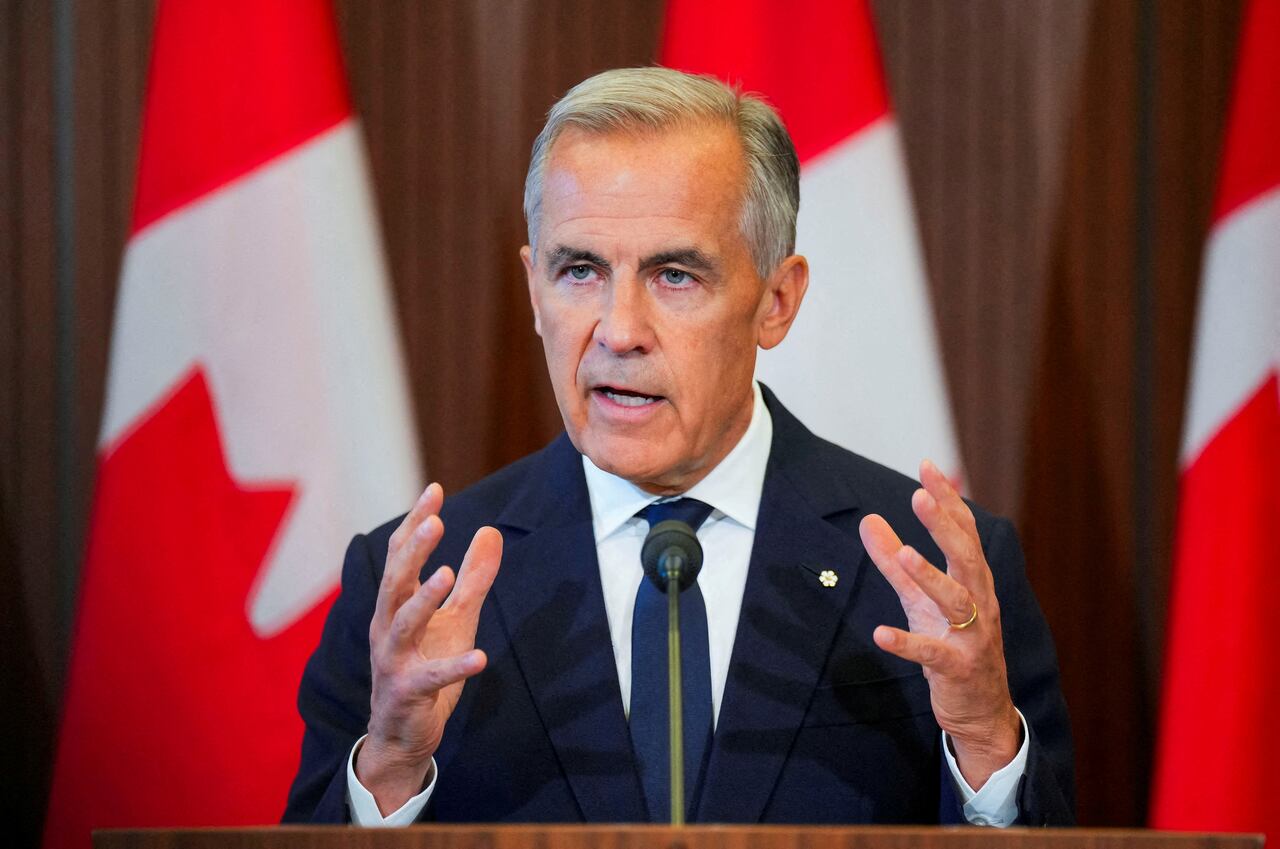
Carney’s strategy for dealing with U.S. President Donald Trump is quietly admired in Europe. (Chris Tanouye/Reuters)
Subdued support
Currently, “discreet” seems to be the key term.
Very few, if any, of Europe’s current leaders have publicly rallied to Carney’s defense during this trade conflict, likely perceiving no clear incentive to provoke Trump’s anger.
Nonetheless, analysts suggest that behind closed doors, Canada’s approach is regarded with respect.
“The fact that Canada has walked away is an intriguing and positive example for Europeans, signifying that one doesn’t have to accept everything,” remarked Tobias Gehrke, a senior policy fellow at the European Council on Foreign Relations.
“You may need to walk away and apply pressure on Washington to achieve a more favorable agreement.”

Protesters assemble on the day of the new U.S. consulate’s opening in Nuuk, Greenland, on May 21, 2026. (Tim Barsoe/Reuters)
Up until now, Europe has only been willing to establish firm boundaries with Trump regarding territorial issues rather than trade.
Trump’s striking attempts to pressure Denmark into relinquishing control of the semi-autonomous territory of Greenland led to widespread condemnation across the EU, U.S. diplomatic isolation, and even a modest military response from Denmark and Europe.
Only after his annexation threat jeopardized the NATO alliance did Trump relent, shifting instead to a vague proposal for future collaboration on Greenland’s resources as a compromise.
Gehrke points out that while Greenland pertains to Europe’s territorial integrity, disputes over commerce fail to ignite the same level of pan-European fervor.
“On straightforward trade matters, whether the tariff is set at 15 percent, 13 percent, or 17 percent, there has been significantly less inclination among Europeans to escalate or to genuinely push back,” Gehrke noted.

U.S. President Donald Trump shakes hands with European Commission President Ursula von der Leyen after the announcement of a trade agreement between the U.S. and EU in Turnberry, Scotland, on July 27, 2025. (Evelyn Hockstein/Reuters)
Lackluster trade agreement
Britain’s pursuit of trade stability with Trump has undoubtedly resulted in outcomes far less favorable than anticipated.
Former Labour Prime Minister Keir Starmer was among the initial leaders eager to negotiate a trade agreement at the beginning of Trump’s second term.
Similar to Europe, many in Britain now perceive that deal as having quickly lost its appeal. British exporters were compelled to accept a baseline 10 percent tariff on most goods shipped to the U.S., with even steeper penalties on steel and aluminum.
However, the real blow came when Trump swiftly extended similar trade agreements to global rivals like Japan and South Korea, immediately diminishing the U.K.’s competitive advantage.
When Washington threatened 100 percent tariffs due to Britain’s existing digital services tax, it left Downing Street in a state of panic. Rather than matching Trump’s aggression, British officials facilitated a retreat earlier this summer, publicly indicating that the domestic tech tax could be “reevaluated.”
Carney highlighted this specific pattern of behavior following the collapse of Ottawa’s negotiations, explicitly cautioning that a U.S. signature under the current administration is frequently “written in pencil.”

An Apple store in Paris. The Trump administration and European governments have been at odds over taxing U.S. tech giants. (Abdul Saboor/Reuters)
Informed audience
Nevertheless, trade experts caution that a fundamental barrier exists that prevents Europe—or the U.K.—from readily adopting the Canadian approach: the trade acumen of the Canadian populace and the harsh reality of economic resilience.
“In Canada, there exists a unique situation where the populace is very much in favor of defending what they perceive as Canada’s interests,” stated Arun Venkataraman, a lawyer at Covington and Burling who formerly worked as a U.S. Commerce Department official in the Biden administration and served as a negotiator in the U.S. Trade Representative’s office during the Obama era.
Venkataraman emphasizes that because Canadians are acutely aware of how closely intertwined their economy is with that of the U.S., their collective readiness to endure the consequences of a failed negotiation is quite exceptional.
“For the Canadian public to be in its current position, strongly backing the stance taken by the prime minister, I think is not easily duplicated in other nations,” Venkataraman remarked to CBC News.
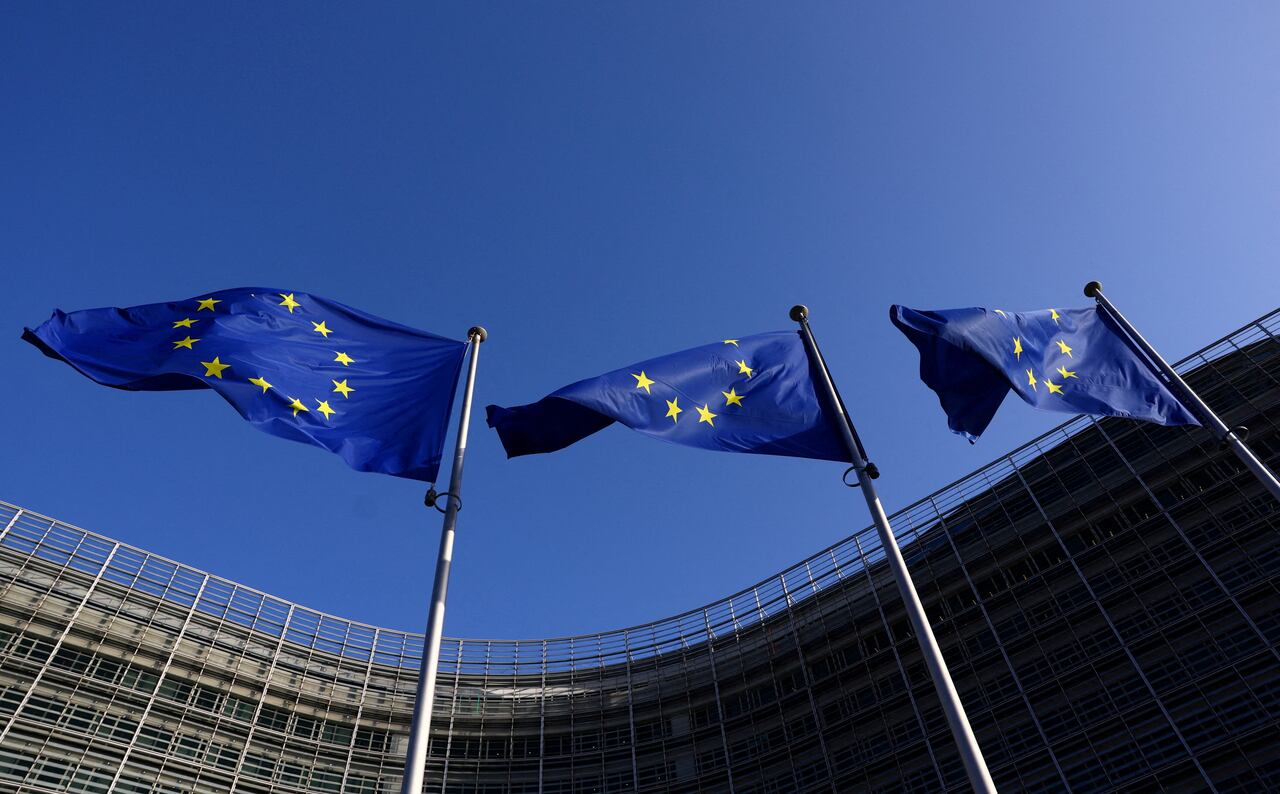
European Union flags wave outside the European Commission headquarters in Brussels, Belgium, on February 26, 2026. (Yves Herman/Reuters)
However, he warns that the dramatic, public nature of Carney’s “no” is merely the beginning of a much longer and more arduous conflict.
“It is one thing to be intellectually prepared to accept the impact that you expect will follow a failed negotiation with the Trump administration,” Venkataraman explained to CBC News.
“It is an entirely different matter to endure that impact, and then face the consequences over time. The duration of these types of conflicts significantly affects and tends to erode whatever political resolve was present at the outset.”
Unstable transition
The decline in political will is precisely why European allies are currently remaining low-profile while the verbal assaults are exchanged.
“Your readiness to make compromises and accept particular agreements at the negotiating table is influenced by your perception of the long-term relationship,” Venkataraman noted, emphasizing that the unpredictable changes in Washington’s reliability “ultimately harm the United States.”

The federal government laid out Canada’s plan to strike back at the U.S., announcing billions in counter-tariffs on hundreds of American products including fish, cosmetics, and furniture.
This waning confidence extends well beyond Ottawa, Brussels, or London.
A June 2026 poll conducted by the Pew Research Center revealed that a global median of merely 23 percent of adults expressed trust in Trump’s leadership.
The report indicated that this decline has occurred “in numerous countries with which the U.S. maintains long-standing economic and security partnerships,” emphasizing that the steepest drops in reliability ratings were observed among America’s closest traditional allies, including Germany and Canada.
Regardless, Venkataraman asserts that despite the challenges faced by Europe, the U.K., and Canada, it is crucial to remember that final agreements—or the lack thereof—are seldom truly final.
“The history of trade negotiations is filled with instances of failed talks that were later revived,” he noted.
“Never say never—it’s understood that sometimes it takes a few of these failures, even dramatic and theatrical ones, to achieve the right outcome.”Â