

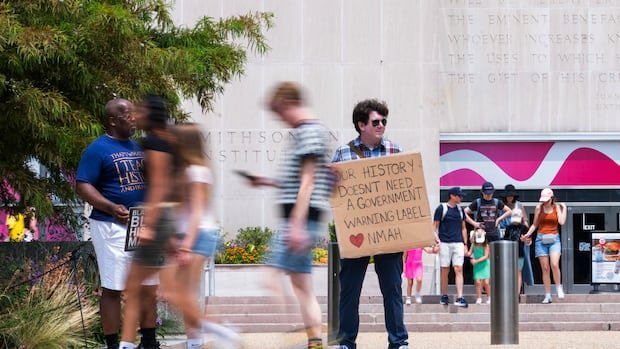

The Smithsonian’s National Museum of American History in Washington, D.C., draws visitors worldwide to see iconic artifacts such as Dorothy’s red slippers from the movie “Wizard of Oz,” inaugural gowns of U.S. first ladies, and the Star-Spangled Banner flag. Recently, protesters outside have been advocating for truth and inclusivity in historical narratives.
The museum is currently embroiled in controversy as the Trump administration seeks to influence the stories presented by cultural institutions in the United States. This move is seen as part of a longstanding effort by conservative groups to align cultural exhibits with right-wing values and limit the influence of independent experts.
President Donald Trump has ordered the installation of signs at the museum warning visitors of potential inaccuracies in the exhibits. These signs are intended to direct visitors to a White House report criticizing the museum’s leadership for alleged political activism and promoting divisive narratives over patriotic ones.
Anthea Hartig, the museum’s director, has defended the institution’s commitment to telling America’s full story accurately. Despite political pressures, the Smithsonian remains steadfast in its mission to preserve historical truth and independence.
Critics, including history professor James Millward, express concerns that the administration’s actions may lead to further politicization of the Smithsonian’s board and a distortion of American history to fit specific agendas.
The Smithsonian, a revered institution with a rich history, holds a vast collection of historical items and artworks. Public support for museums remains high, with a growing demand for inclusive content that reflects diverse perspectives.
As debates over historical narratives continue, visitors like Amy Carlson Miesel and student Tan Tran reflect on their museum experiences, highlighting the importance of presenting a balanced portrayal of American history that acknowledges both achievements and challenges.