

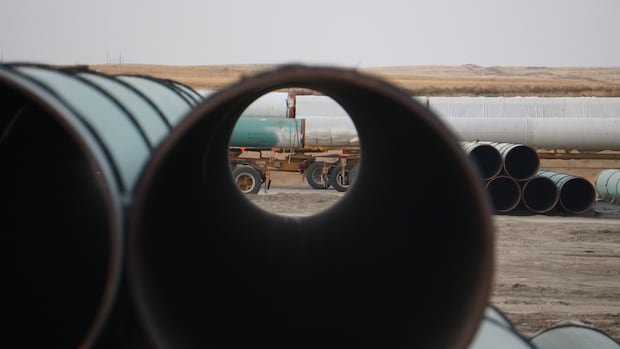

U.S. President Donald Trump has hinted at the revival of the Canada-U.S. Keystone XL oil pipeline project, suggesting it could be resurrected under a new trade agreement between the two countries. However, industry experts caution that Trump’s statement may be more politically motivated than driven by the petroleum industry.
In a recent social media post, Trump announced a “deal” with Canada just before the implementation of new tariffs on Canadian goods. Referring to his predecessor, he mentioned that the Keystone XL Pipeline, previously canceled by Joe Biden, might be brought back to life.
Prime Minister Mark Carney did not directly respond to Trump’s post. Dennis McConaghy, a former executive at TransCanada Corporation, noted that Trump’s signal regarding Keystone XL could impact Carney’s upcoming decisions amidst ongoing trade negotiations.
Since imposing tariffs on Canadian goods in 2025, Trump has maintained a stance that the U.S. could do without Canadian imports, although certain commodities like oil have been excluded from tariffs. The potential revival of Keystone XL has garnered mixed reactions from experts, with some highlighting the project’s historical environmental and political challenges.
While some believe that Carney may find it easier to advance the project than Trump, uncertainties remain about the feasibility of reviving Keystone XL given the evolving market dynamics and potential future political shifts.
The Keystone Pipeline System, owned by South Bow Corp., plays a crucial role in delivering Canadian and U.S. crude oil to refining markets in the U.S. Despite previous setbacks, discussions around reviving Keystone XL have resurfaced, with ongoing considerations about its economic and strategic significance.
South Bow’s involvement in the Prairie Connector project, utilizing parts of the Keystone XL pipeline, aims to enhance Canada’s crude oil exports to the U.S. Former TransCanada executive McConaghy emphasized the potential value addition of the Prairie Connector project, highlighting its importance in meeting long-term energy demands.
As discussions around Keystone XL and related projects continue, the energy sector remains optimistic about the future demand for Canadian crude oil in the U.S. and the resilience of refining markets in the Gulf Coast region. Despite these developments, final decisions on project investments are pending, reflecting the complex nature of cross-border energy initiatives.