

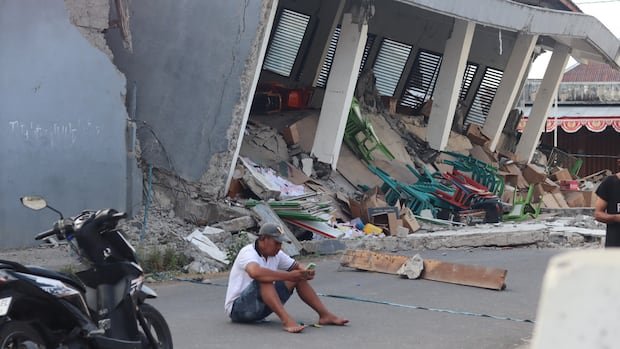

Around 5,000 individuals have been relocated following a powerful magnitude-7.7 earthquake that struck an area in eastern Indonesia, resulting in a death toll of at least 53, road blockages, and landslides, as reported by authorities on Sunday. More than 130 individuals sustained injuries, with many suffering from fractures.
This seismic event on Saturday stands as the most fatal in the Southeast Asian country since a 2022 earthquake in West Java claimed the lives of hundreds. The Sikka region witnessed over 3,300 people either self-evacuating or seeking refuge in a sports arena, according to the disaster mitigation agency BNPB.
In the aftermath, some residents of Sikka found themselves stranded outside collapsed residences, seeking shelter under makeshift tarps. Meanwhile, others received medical attention in temporary tents outside a hospital in Maumere, a port town.
Simon Subandi, the deputy regent of Sikka, shared that nearly all residents opted to sleep outdoors on porches or makeshift tents due to safety concerns following the quake. Responding to the crisis, over 3,500 military and police personnel have been dispatched to the affected region, confirmed Cabinet Secretary Teddy Indra Wijaya.
Concerns about aftershocks loom large among residents, particularly in Maumere, where a port has been rendered inoperable by debris from collapsed structures. The disaster agency disclosed that nearly 1,000 aftershocks have been recorded since the initial quake, prompting hundreds of individuals to seek refuge in a designated sports stadium.
As the community copes with the aftermath, Margaretha Movaldes Da Maga Bapa, the head of the region’s disaster mitigation agency, expressed how the recent seismic activity evoked painful memories of past earthquakes, especially the 1992 incident. Search and rescue operations continue in the worst-hit areas, with efforts focused on clearing rubble in Manggarai, East Manggarai, and Nagekeo to locate any individuals possibly trapped beneath debris.
While power restoration efforts are nearing completion, repairs to distribution lines are ongoing, as per state utility firm Perusahaan Listrik Negara. An emergency declaration for the province by the East Nusa Tenggara government, facilitated by BNPB, enables the mobilization of resources and funding to address the crisis.
Geology expert Dwikorita Karnawati highlighted the seismic vulnerability of the region due to the “Flores back-arc thrust fault,” a significant network of west-east thrust faults. The same area was struck by a magnitude-7.5 earthquake in 1992, causing widespread devastation, as indicated by Indonesia’s geophysics agency.
Indonesia, home to a population of 290 million across its vast archipelago, straddles the “Pacific Ring of Fire,” a volatile zone where tectonic plates intersect, leading to frequent seismic activities and volcanic eruptions.