

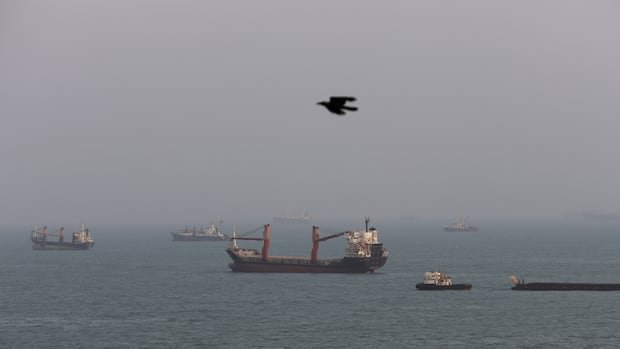

U.S. President Donald Trump stated on Tuesday that there were no ongoing discussions with Iran and affirmed that the Strait of Hormuz was open, opposing Iran’s claim that the vital water passage was closed to shipping. The diminishing likelihood of reaching a resolution to the nearly six-month conflict led to a rise in oil prices, a decline in stock markets, and an increase in borrowing costs for major economies, including the U.S., due to concerns about long-term inflationary and fiscal effects.
A temporary ceasefire pact expired on Monday, prompting a senior Iranian official to announce that Iran was transitioning to a “fully offensive” military stance because of the diplomatic impasse. Despite this, there were no reports of new attacks from either side on Tuesday. Trump, posting on Truth Social, affirmed, “There are no talks or conversations happening or planned with the Islamic Republic of Iran.”
Jared Kushner, Trump’s son-in-law and special envoy, had expressed optimism on Monday, suggesting that talks with Iran were ongoing and more substantial than ever. The conflict, which commenced with joint U.S.-Israeli strikes on Iran, has evolved into a standoff, with Iran threatening shipping in the strait while Washington warns of potential renewed attacks if negotiations do not lead to a lasting resolution.
A key objective for the U.S. is to prevent Iran from obtaining nuclear weapons, a challenging task that experts believe cannot be achieved without addressing the enriched uranium allegedly buried at previously targeted sites by the U.S. military.
In spite of Trump’s positive remarks about the Gulf situation improving, reports from various countries continued to highlight attempts to disrupt shipping activities. The United Arab Emirates’ Defense Ministry disclosed the detection of two ballistic missiles launched from Iran, marking the first such incident since an earlier strike on the Fujairah port. The UAE Foreign Ministry suspended all trade activities with Iran, citing regional escalation that undermines peace and security.
Furthermore, a vessel transiting through the Strait of Hormuz reported being struck by an unidentified projectile, resulting in engine room damage and crew casualties. The Omani Coast Guard was providing assistance to the affected crew. Iranian negotiator Mohammad Baqer Qalibaf emphasized that the strait would remain closed until the U.S. fulfilled the conditions of an interim agreement signed in June.
As the agreement’s 60-day timeframe expired on Monday, Trump indicated no intention to extend it, leading to a breakdown over disputes regarding control of the Strait of Hormuz, a critical passageway for global oil and liquefied natural gas transport. Iranian officials stressed their readiness for dialogue with the U.S. while emphasizing that negotiations should not be misconstrued as surrender.
Despite projecting resilience, Iranian leaders are concerned that further economic sanctions could worsen hardships, reignite unrest, and undermine the Islamic Republic’s legitimacy. The conflict has resulted in numerous casualties, primarily in Iran and Lebanon, with Iran targeting U.S. military installations and infrastructure across multiple countries. Brent crude oil prices have surged during the conflict, settling at over $91 a barrel on Tuesday.
A U.S. administration official warned of additional actions to impact Iran’s economy through sanctions in the coming months. The situation remains tense, with potential for further escalation in the ongoing conflict.