

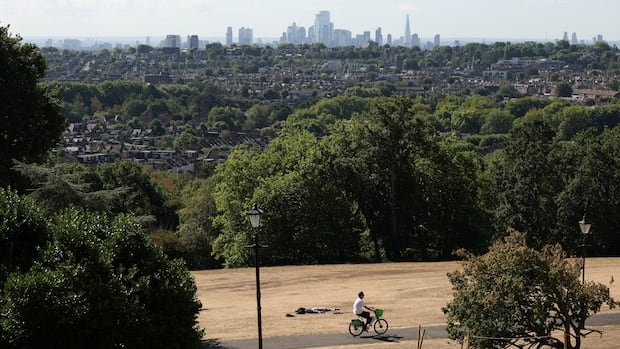

In the midst of a heatwave and severe drought in Britain this summer, Divya Hariramani was trimming a plum tree in south London when she noticed an issue with one of the tree’s branches. The branch was starting to split from the tree, a sign of stress on the fruit tree as explained by workers at Mitcham Community Orchard.
Hariramani, who showcases fruit trees and their caretakers across the city on her social media account called Fruity Walks, attributed the problem to the heat causing water scarcity for the trees, leading to parts dropping off.
While London is globally recognized for its historic stone architecture, the city is also celebrated for its extensive urban forest, considered one of the largest worldwide. However, the urban canopy has faced challenges this year due to five consecutive heatwaves and a significant lack of rainfall, impacting plants and wildlife.
A recent report by Royal Botanic Gardens Kew predicts that by the end of the century, around 73% of London’s trees could be in danger of dying due to climate change. The report highlights that a majority of public trees in London are currently ill-suited to future climate conditions, with a substantial percentage already deemed vulnerable.
The effects of climate change are already visible, with 400 trees at Kew Gardens succumbing to extreme heat and drought in 2022. The remaining red oak tree has been left as a poignant symbol of the impact of climate change on London’s trees.
Kew Gardens revealed these findings ahead of Climate Action Week in June, coinciding with a severe drought in Britain. The dry conditions led to crop losses, warnings of food shortages, and wildfires in parts of the country. The scorching weather also caused park grass to wither, leaves to droop, and trees to shed their foliage prematurely, transforming the summer landscape into an autumn-like scene.
Looking ahead, experts are considering planting tree species more suited to London’s future climate, which is projected to resemble Barcelona’s current climate by 2050. The goal is to identify trees that can thrive in hotter, drier conditions while enduring England’s wet winters.
Paul Wood, an author known for his writings on London’s trees, expressed concerns about the impact of climate change on the city’s green spaces. He emphasized the historical significance and ecological value of London’s ancient woodlands, where trees dating back centuries provide essential biodiversity and a link to the city’s past.
In the face of record-breaking heat and drought, preserving London’s urban tree canopy becomes a critical challenge to safeguard the city’s environmental heritage and ecosystem balance.