

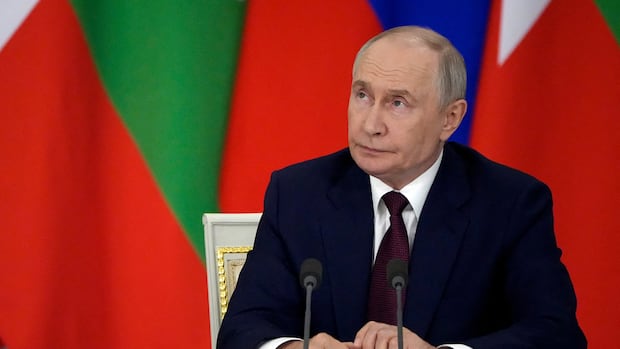

As the conflict between Russia and Ukraine approaches a critical juncture, a notable U.S. intelligence mission to Moscow this week has exposed a divided discussion among allies regarding Vladimir Putin’s forthcoming strategies.
For several weeks, experts have speculated that the Russian president has abandoned hopes that U.S. President Donald Trump could persuade Ukraine to accept his extreme surrender demands. Analysts suggest that Putin may have concluded that his prolonged conflict against Ukraine can only end by escalating the hostilities.
With the Russian economy deteriorating and the number of volunteers willing to fight in Ukraine declining, Putin might be considering several alternatives.

Men sitting beside a recruitment billboard for military service in downtown Moscow, Russia, August 27, 2026. (Ramil Sitdikov/Reuters)
Ukrainian intelligence sources believe a widespread, unpopular mobilization is imminent, potentially sending hundreds of thousands of new conscripts into combat, aiming to overwhelm Ukraine’s overstretched defenses.
Soldiers from Russia’s economically disadvantaged areas have comprised a significant portion of the fighting force in Ukraine. A nationwide mobilization could include men from more prosperous urban centers.
Military analysts on both sides of the Atlantic have also cautioned that Putin might attempt to fracture NATO’s unity by orchestrating provocations in Eastern Europe to test the alliance’s resolve.

Prior to a meeting with Ukrainian President Volodymyr Zelenskyy in Ankara, Turkey, on Tuesday, Prime Minister Mark Carney denounced Russian President Vladimir Putin’s aggression against Ukraine, stating that the pressure on Russia ‘is only going to increase.’
Suspected and confirmed hybrid assaults from Russia across Europe — including attempts at assassination, sabotage, and frequent drone incursions — have escalated recently. However, strategists remain apprehensive that Russia might be tempted to occupy a portion of Russian-speaking territory in a neighboring nation to gauge the alliance’s reaction.
Russian officials have indicated this week that they could potentially target Western arms manufacturers supplying Ukraine, especially in Great Britain.
Unusual visit
The speculation regarding Putin’s upcoming actions heightened earlier this week following the unexpected visit of CIA Director John Ratcliffe to Russia.
Instead of using a private jet, which is typical for covert diplomatic missions, Ratcliffe landed at Vnukovo airport on a large, highly noticeable U.S. Air Force C-17 Globemaster.
The flight’s transponder openly transmitted its path across the Atlantic.
U.S. officials seemed to want the global community to recognize the significance of Ratcliffe’s Moscow visit and that there was a specific message they wished for the Russians to understand.
“It reached a point within the administration where they concluded, ‘We need to deliver a strong message to the Russians,’” remarked Glen Howard from the Saratoga Foundation, a Washington, D.C.-based security think tank focused on Ukraine.

A C-17 Globemaster, thought to be carrying CIA Director John Ratcliffe, arrives near Riga, Latvia, on August 25, 2026, in this frame from a social media video. (AlfredSpodins/X/Reuters)
But what was the purpose of Ratcliffe’s visit?
Initially, the Wall Street Journal reported that the mission was essentially an ultimatum to Putin: Halt the escalating hybrid sabotage against NATO’s eastern flank or face a direct allied response.
Military strategists have long speculated that Putin might attempt to draw the United States or NATO into the war directly to secure a favorable resolution in Ukraine. Provoking a minor attack on a small Baltic state could test NATO’s Article 5 collective defense clause.
However, the following day, Trump appeared to downplay this narrative, expressing he wasn’t concerned about a Russian aggression against NATO and labeling Ratcliffe’s visit as “semi-routine.”
Shortly after, the New York Times released an article aligning more with Trump’s comments, suggesting NATO was not the primary focus of the discussions; rather, the warning was directed at Putin to cease his conflict in Ukraine before Russia’s economic and military situation worsens.

Latvian National Guard servicemen search a field for debris from an intercepted drone in Rugaji, Latvia, on August 14, 2026. (Janis Laizans/Reuters)
Canada’s commitment
Canada’s largest military deployment abroad is situated in the Baltics, with over 2,000 soldiers stationed in Latvia, tasked with deterring any Russian expansionism in the region.
Canadian military and security specialist Wesley Wark does not believe that Putin is keen on provoking NATO directly, even as the U.S. faces political and military strains due to the ongoing conflict in Iran.
“I think fears regarding Article 5 are exaggerated,” Wark stated in an email to CBC News. “My primary assumption is that Ratcliffe’s trip to Moscow was to convey a serious message about the U.S. commitment to impose economic sanctions against Iran, with a caution for Russia not to meddle.”
Russia is a crucial military ally of Iran, and Putin’s government may be providing Iran with targeting information to assist in strikes against U.S. military installations in the Persian Gulf.
The immediate response from nations such as Latvia to Ratcliffe’s visit also downplayed the likelihood of confrontation with NATO. The Latvian foreign minister shared on social media that “Latvia’s threat assessment remains unchanged.”

Ukrainian President Volodymyr Zelenskyy and British Prime Minister Andy Burnham greet each other ahead of their meeting at Horodetskyi House in Kyiv, Ukraine, on August 24, 2026. (Henry Nicholls/Reuters)
In contrast, British intelligence agencies, where Putin’s operatives have notoriously conducted previous attacks, including the deadly 2018 Novichok poisoning in Salisbury, have cautioned that sensitive sectors within the defense industry should remain vigilant.
On Wednesday, Russian foreign ministry spokesperson Maria Zakharova issued unusually direct threats, indicating that Russia could target locations within and beyond the U.K. if the British government continued its support for Ukraine.
During his recent visit to Kyiv, Prime Minister Andy Burnham announced plans to provide Ukrainians with the blueprints necessary to construct their own long-range missiles capable of striking deep into Russia.
Escalation against Ukraine
Ukrainian officials are convinced that the potential Russian threats against NATO, Great Britain, and other European targets are mere diversions, with the expectation that Putin’s escalation will primarily focus on them.
“I believe Putin sees an opportunity,” stated Yuriy Boyechko, who leads the U.S.-based Hope for Ukraine, a humanitarian organization that delivers emergency supplies to the country following Russian bombings.
“I anticipate that this winter, Putin aims to inflict pain and despair upon Ukrainian society due to shortages of energy or food… which may lead them to turn against the Ukrainian government.”
While Putin’s strategy is set to impose significant hardships on Ukraine in the forthcoming months, he insists it will not crush the nation’s spirit.
“Historically, none of his tactics have succeeded. So I remain hopeful about that.”

Members of the 93rd Kholodnyi Yar Separate Mechanized Brigade of the Ukrainian Armed Forces firing a BM-21 Grad multiple launch rocket system at Russian forces near Kramatorsk, Ukraine, on August 4, 2026. (Iryna Rybakova/Press Service of the 93rd Kholodnyi Yar Separate Mechanized Brigade of the Ukrainian Armed Forces)
The intensity of missile strikes on Kyiv and other urban areas has surged recently, with reports indicating as many as 800 Russian drones being deployed in a single night.
The lack of interceptor missiles, such as the U.S.-made Patriots, has rendered cities defenseless and led to a rise in civilian casualties.
Boyechko believes that as Ukrainian cities continue to face terror, Putin will utilize his newly mobilized recruits to attempt to breach the country’s defenses in the south.
“He hopes that these 600,000 new soldiers will manage to punch through the front lines and seize territories. His ambition extends beyond just Donetsk, Luhansk, or Zaporizhzhia — he aims to reach Kyiv.”
Mobilization challenges
Putin reportedly believed that the invasion he initiated in February 2022 would be resolved within days and that Kyiv would easily capitulate. In reality, Western sources suggest Russia has incurred up to 1.4 million casualties, including the killed, injured, or missing.
A mass mobilization poses risks for Putin, according to Howard from Saratoga. It is likely to be highly unpopular and could lead to a new wave of emigration from Russia. Additionally, civilian industries and agriculture may suffer from a lack of workforce needed to sustain essential supply chains and support Russia’s wartime economy.
“He may attempt to gradually build forces,” Howard remarked.
Regardless of whether Ratcliffe’s recent flight was intended to reinforce NATO, safeguard the Baltics, or isolate Iran, the harsh reality suggests that Ukraine will absorb the immediate impact of whatever course Putin decides to take.