

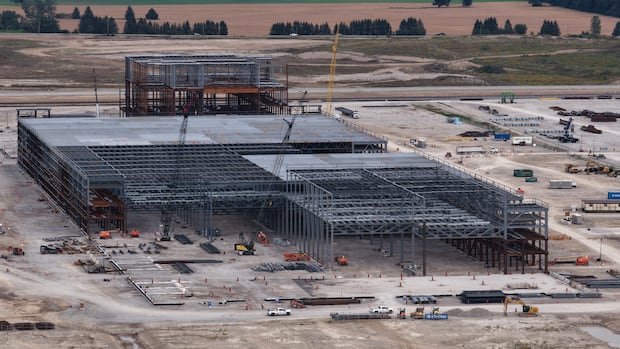

The electric vehicle industry has seen delays, cancellations, and significant changes in major EV and battery projects across Ontario, Quebec, and British Columbia. Automakers and suppliers are adjusting to lower-than-expected demand, leading to setbacks in government investments. Volkswagen’s PowerCo battery plant in St. Thomas, Ont., has pushed back production to 2029 due to evolving market demand, highlighting challenges in Canada’s EV investment strategy regarding scale and location.
Critics question whether Canada overestimated the speed of EV market growth, with concerns that demand may not meet the expected levels for battery production. However, supporters argue that these delays are part of a long-term shift towards electrification.
Grieg Mordue, a former Toyota executive, points out inefficiencies in the St. Thomas plant’s scale and location, as the batteries would need to travel long distances to reach VW’s assembly operations in the southern U.S. and Mexico. Despite these challenges, VW views the plant as crucial to its North American battery strategy and plans to incorporate newer technology while scaling production based on demand.
Joanna Kyriazis from Clean Energy Canada emphasizes the long-term nature of these investments, suggesting that the current slowdown in EV demand is a transitional phase rather than a sign of excessive battery capacity. The market for EV batteries extends beyond vehicles to grid-scale storage, aligning with Canada’s goal to remain competitive in the evolving auto industry.
While some question the sustainability of government policies promoting EV adoption, others believe that these investments are essential for Canada’s auto industry survival in the 21st century. The shift towards electric vehicles is a global trend, and Canada aims to secure a place in this evolving market.
The challenges in the EV sector underscore the need for continued innovation and adaptation to meet changing market dynamics. Despite current market conditions, the long-term outlook for EVs and battery production remains promising, positioning Canada to play a significant role in the global transition towards electric mobility.