


It’s a widely accepted belief that individuals who already possess significant wealth and influence are always driven to acquire more of both.
This is because throughout history, neither riches nor power have been known to enhance one’s wisdom or appearance. A quick glance at Jeff Bezos serves as a clear example, and a second look at his spouse further confirms this notion.
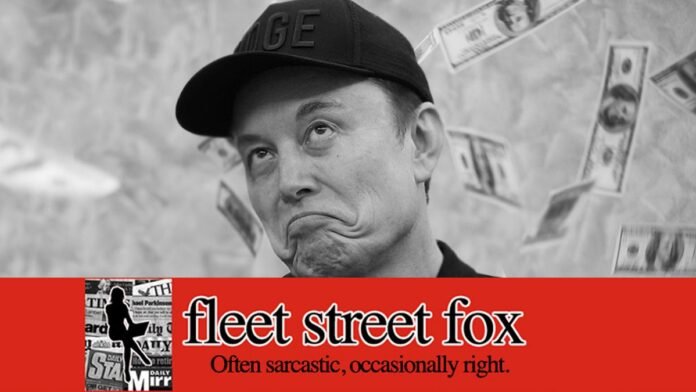
Today, Elon Musk, currently the wealthiest individual globally with a personal fortune of £380 billion, has secured approval from Tesla shareholders for a compensation package that could potentially elevate him to the world’s first trillionaire within the next two years.
The real query is not just whether he will achieve the necessary corporate milestones to qualify for this status, but rather what the ultimate purpose of such an accumulation is. After all, there is hardly anything on this planet, or even within close Earth orbit, that is currently beyond his reach.
Musk possesses an immense amount of wealth, to the extent that he could feasibly purchase entire nations. In reality, he has essentially gained control over the largest economy globally. By contributing substantial sums to Donald Trump’s re-election campaign and diverting attention with various strategies, Musk ensured the protection of his multi-billion dollar government contracts. Furthermore, he managed to halt unfavorable investigations into his companies, thereby minimizing regulatory risks. Consequently, he retreated from the public eye to focus on his enterprises, as if that hadn’t been his primary focus all along.
He is not preoccupied with concerns about affording additional offspring or facing paternity disputes. Musk is not fretting over reducing heating expenses, calculating grocery bills, or pondering how to cover the mortgage, as many individuals do daily. Instead, he has established a residential community for his family in Texas, although he reportedly maintains limited contact with them. Moreover, he purportedly spends most nights alone in a prefabricated studio apartment that he leases from his own company, valued at around £38,000.
While Musk has indulged in personal expenditures, such as undergoing hair restoration procedures, his appearance has notably altered. However, being wealthy is not entirely enjoyable, as everyone seems to have ulterior motives when dealing with him. It is reasonable to assume that at some point in the supply chain of providing Musk with goods, services, or attire, individuals are likely padding their bills for personal gain.
With his vast wealth, Musk could theoretically consume all the cake in the world and hire someone to remove the resulting fat from his body. He could acquire any vehicle, residence, or business, travel to any destination, and engage in any activity. He could enter palaces uninvited and purchase King Charles and his possessions numerous times over. So, what more could he possibly desire?
Perhaps he could liquidate all his assets, amass the funds into a massive pile, and immerse himself in it. However, this action would likely lead to the collapse of the global economy and dangerously thin the Earth’s crust due to the extensive mining required to generate physical cash, ultimately resulting in his demise within molten lava. Hence, this notion might not be a prudent course of action.
Musk is the first individual whose personal wealth could propel him, or at least his interests, into outer space. While Bezos has briefly ventured into the stratosphere and Richard Branson experienced zero-gravity conditions, Musk stands out with a personal satellite network capable of influencing warfare and information dissemination. He possesses rockets capable of intricate maneuvers, like reversing into parking spaces. With additional resources, he could potentially reach the Moon and has aspirations regarding Mars. However, the likelihood of his survival on such ventures remains uncertain, and his wealth could be rendered obsolete.
This scenario could be advantageous, considering Musk’s reluctance to share benefits with others. At times, he complies with income tax requirements, while other instances see him exempt from such obligations. His enterprises rely on government subsidies and have occasionally paid minimal federal taxes in return. Since the bulk of his wealth exists in the form of stocks and shares, he only incurs taxes upon their liquidation. Consequently, if he opts for budget-friendly meals in his modest prefab residence, his expenses are significantly reduced.
Hence, the trillion-dollar valuation he aspires to achieve is not tangible wealth but rather a conceptual notion based on his ownership percentage in Tesla and the perceived worth of the company if sold, which remains unlikely to transpire due to potential tax liabilities and diminished influence. This fundamental aspect underpins the overarching narrative of extreme wealth.
The proposed arrangement Musk seeks would not directly increase his