

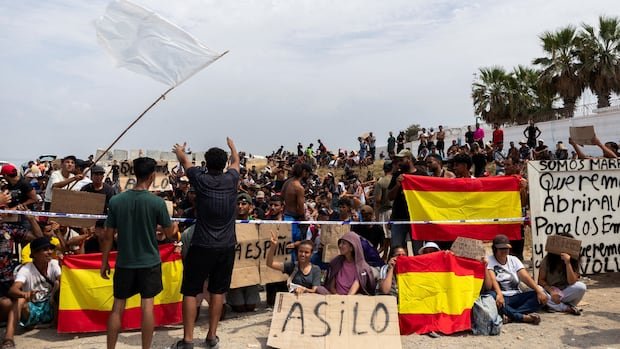

Hundreds of migrants who recently arrived in Spain’s North African enclave of Ceuta demonstrated on a popular urban beach on Sunday, calling on Spanish authorities to grant them asylum rather than returning them to Morocco. These migrants are part of the estimated 5,000 to 8,000 individuals who remain in Ceuta following a large-scale border crossing two weeks ago, which witnessed over 72,000 people entering the small territory with a population of about 80,000. The majority of the migrants voluntarily returned in the subsequent days.
Due to the strain on the city’s resources, most migrants are living in precarious conditions on El Trampolin beach or the outskirts of the city while waiting for an opportunity to travel to continental Europe. Ayoub Elarroud from Tetouan, Morocco, expressed the difficulties they face, including sleeping near the sea in cold and unpleasant conditions, with limited access to the city center due to police restrictions.
During the protest, migrants displayed Spanish flags and banners with messages like “We don’t want to go back to Morocco” and “We are also human,” while voicing their exhaustion and the need for a solution. On the rocky shores, some migrants were seen washing clothes and fishing with makeshift bamboo rods.
Interior Minister Fernando Grande-Marlaska stated earlier that irregular migrants would not be allowed to stay in Ceuta, move to mainland Spain, or obtain legal status, except in exceptional cases of extreme vulnerability.
Ceuta’s medical board chief, Enrique Roviralta, highlighted the exhaustion of health-care workers and criticized the slow response from the central government. He mentioned the rise in diseases like infectious diarrhea and scabies, along with an increase in violence-related injuries such as broken noses and stab wounds.
Health Minister Monica Garcia rejected claims of a collapsed health system but acknowledged the pressure it is under, mentioning a moderate risk of epidemic outbreaks among migrants. Most Moroccan migrants interviewed cited poor working conditions in their country as their reason for seeking a better life in Europe.
One migrant, Hicham Chikir, expressed the eagerness of many to work in Europe, emphasizing the consequences of police intervention for those who misbehave. Emmanuel, a Nigerian electrician fleeing conflict, embarked on a dangerous journey to provide a better future for his children.
Other migrants, like Mohammad Ismail Hossain from Bangladesh and Ousmane from Senegal, shared their arduous journeys and reasons for seeking asylum in Ceuta. Ousmane mentioned facing persecution due to his sexual orientation and the frustration of awaiting responses from local NGOs.
The situation in Ceuta remains complex as authorities work to address the challenges posed by the influx of migrants and the humanitarian needs of those seeking refuge.