

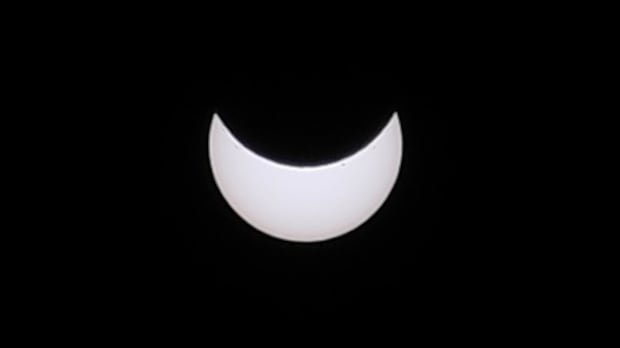

On Wednesday afternoon in Newfoundland and Labrador, a partial solar eclipse was visible depending on the weather conditions. The partial eclipse was first observed in Churchill Falls at 1:37 AT (2:07 NT) and gradually spread across the province. The eclipse was expected to conclude in St. John’s at 4:37 p.m. NT, with the moon covering about 50% of the sun’s surface.
At the Johnson Geo Centre in St. John’s, spectators gathered for a watch party equipped with special safety glasses to witness the moon passing in front of the sun. The event, held from 12 p.m. to 5 p.m., was organized in collaboration with the Royal Astronomical Society of Canada and STEM Girls.
Astronomer Hiding Neilson from Memorial University described the experience of observing the moon “eating the sun up” through a telescope as wonderful. He emphasized the rarity of a partial eclipse, occurring approximately once every 50 years.
Andrea van Nostrand, the Geo Centre’s lead of education and interpretation, highlighted the excitement of the event, noting that children could participate in activities to create solar viewing tools for safe viewing. She expressed the spectacular nature of seeing an object move across the sun with the aid of viewing glasses.
The total solar eclipse would be visible across Greenland, Iceland, Spain, and a small part of Portugal. Two years prior, a mother-daughter duo, Jennifer Waye and Gabriela Fuentes Waye, were inspired by a previous eclipse to travel to Spain for the current event due to favorable weather conditions and personal connections.
In Canada, regions further north and east, such as Alert, Nunavut, were expected to witness a more complete solar eclipse, with 94% coverage. This event was anticipated to attract significant interest from the public and astronomers alike.