

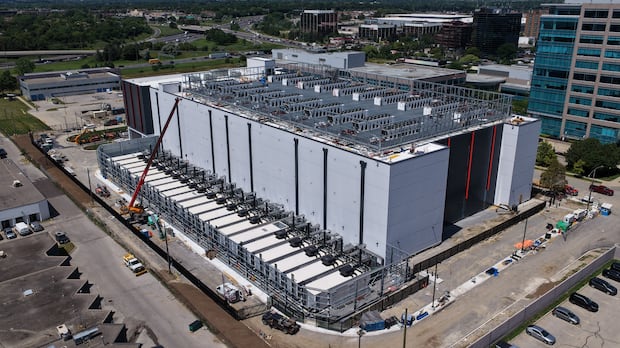

Experts and government officials believe that Ontario’s newly introduced data centre framework will assist municipalities in managing the presence of large-scale data centres within their jurisdictions.
On Thursday, Premier Doug Ford unveiled the framework in Guelph. This framework evaluates data centre approvals based on three key aspects: economic growth, data security and sovereignty, as well as community investment and public trust.
Carmi Levy, a technology analyst, pointed out that these guidelines will provide uniformity for communities still forming their policies regarding data centre developments.
“Until now, it has been the responsibility of each city, region, and sub-provincial government to establish their own regulations,” Levy, who resides in London, Ontario, explained. “It has essentially been a chaotic situation, potentially resulting in a mix of communities across the province where some are open to data centres and others are not.”
“I was pleased to see the provincial government take the lead,” he added.

Ontario Premier Doug Ford has announced the province’s new data centre framework. The framework provides data centres with rules that aim to address concerns around their cost and energy use, as well as data protection issues.
The framework outlines strategies for attracting data centre projects that promise “substantial investment and tangible benefits for host communities.”
As per the outlined criteria, data centres must contribute both financially and through other means to their communities, which can include job creation, training programs, and infrastructure improvements.
Additionally, data centres are required to bear the complete cost of their electricity and any necessary operational upgrades. The framework ensures that residents’ electricity expenses will not be influenced by the presence of data centres.
“Our framework guarantees that data centres will cover their entire electricity costs, which promotes the establishment of their own power generation and introduces a distinct rate class for large new data centres, set higher than the industrial rates for major electricity consumers,” Ford explained during the announcement.
“No expenses will be transferred to the hardworking families of Ontario.”
-
Ontario unveils new data centre framework amid calls for moratoriums
-
Here’s Essex County’s ‘first step’ to ready itself for AI data centre proposals
The framework also highlights that the province will leverage its strategic assets, such as its cool climate and skilled labor force, to attract new data centres instead of relying solely on financial incentives.
New data centres are anticipated to utilize technologies that minimize both environmental and community impact, as stated in the framework. This includes sound-reduction engineering and closed-loop cooling systems, which involve the recycling of cooling fluids rather than the continuous use of freshwater.
‘My stance hasn’t changed,’ one mayor states
This announcement arrives as municipalities throughout the province deliberate on how to approach the contentious issue.
Oakville recently voted to implement a one-year moratorium on data centres, becoming the first municipality in Ontario to do so. Mississauga is preparing to vote on its own moratorium in September.
Essex County councillors have recently passed a motion to reassess land use policies in anticipation of potential AI data centre proposals. Meanwhile, Waterloo Region and Toronto councils are instructing staff to examine the implications of data centres.

Strathroy-Caradoc’s Mayor Colin Grantham is vocal about his opposition to large-scale data centres in his community. (Colin Grantham/Facebook)
Strathroy-Caradoc Mayor Colin Grantham is one of the most vocal opponents of establishing a data centre in his area.
Last month, the municipality received a rezoning proposal for a section of land, which included the construction of a data centre as one of its intended uses. The developer has since withdrawn that aspect of the application.
Grantham mentioned that the provincial announcement has clarified some of the questions he and local residents had regarding the growing industry.

A rezoning application in Strathroy could expand a property’s permitted uses to include a data centre, among other changes. Mayor Colin Grantham joins Afternoon Drive to explain why he’s not in favour of it.
“I think everyone acknowledges that data centres are essential. One cannot halt their development, regardless of whether it’s AI or the amount of computing power we require these days,” he stated. “I don’t believe people are truly against them; they simply seek assurance that their lives won’t be adversely affected.”
“[The framework] provides me with some reassurance. It signifies that the Premier and government are attentive to the concerns of the public and acknowledge the need for protective measures.”
However, Grantham expressed that his opinions regarding developments in his community remain unchanged.
“My position on data centres in urban areas hasn’t shifted,” he remarked.
Demands for additional legislation
Grantham regards the framework as a “first step” toward establishing comprehensive provincial regulations governing large-scale centres.
“We require regulations concerning environmental impacts, energy consumption, water usage, and designated locations for these centres,” he stated. “Such regulations must be enforced by law.”
Levy anticipates forthcoming provincial and federal legislation, especially in light of Prime Minister Mark Carney’s AI strategy, which was released in June.
-
Mississauga councillors want to pause data centre builds for a year. Here’s why
-
Toronto residents push for moratorium on data centres in city, raise concerns over environmental impact
“A framework is merely the initial phase before implementing a comprehensive law,” Levy remarked. “I expect to see AI-focused legislation that specifically addresses regulations surrounding data centres.”
Levy emphasized the necessity for Canada to remain vigilant regarding the rapidly expanding data centre sector.
“Ultimately, these facilities must be constructed if we wish to engage in the digital economy. Simply claiming ‘not in my backyard’ is no longer a sufficient stance.”