

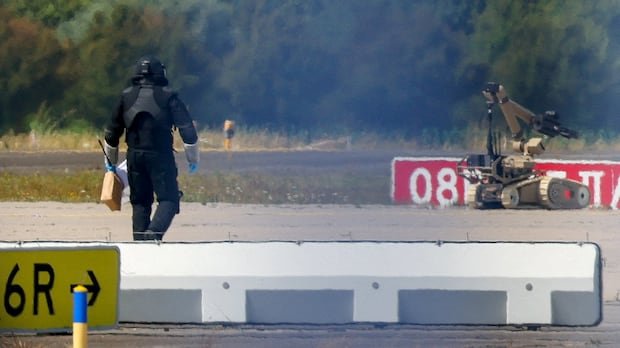

German authorities are currently investigating a drone containing explosives and a detonator discovered at Leipzig airport, while Russian Foreign Minister Sergey Lavrov has indicated Moscow’s intention to increase retaliatory actions against countries supporting Ukraine.
In an interview with VGTRK, Russia’s state media, Lavrov stated, “We will employ more severe measures to dismantle everything facilitating the West’s support for Kyiv’s military capabilities. We are already taking steps in this direction.”
The drone, carrying an unidentified explosive device, was found in the cargo operations security area near the south runway of Leipzig airport, deemed as “critical infrastructure.” Leipzig serves as a key NATO airport for transporting armaments, ammunition, weapons, and other military supplies to Ukraine through flights operated by Ukrainian cargo carriers.
The presence of the drone, discovered adjacent to a Ukrainian cargo plane, represents a heightened level of threat for Germany, according to the country’s interior minister, Alexander Dobrindt. He characterized the incident as part of a sophisticated “professional hybrid threat scenario,” rather than the work of amateurs.
German authorities are conducting a thorough investigation into the drone incident without disclosing its origin. Recent intelligence reports from U.S. officials to the Wall Street Journal suggested possible links of the drone to the Russian government.
While Berlin is cautious in its response, it is enhancing anti-drone capabilities and refraining from premature attributions. Dobrindt emphasized the ongoing fact-finding process and refrained from making premature comments as a federal minister.
Authorities have cautioned about Russia’s utilization of drones, espionage, sabotage, and influence operations across Europe, especially leading up to the upcoming regional elections in Germany. Dobrindt highlighted the evolving threat landscape faced by Germany on a daily basis.
In a recent development, Germany is experiencing a surge in hybrid warfare activities, including espionage, sabotage, cyber attacks, and covert actions orchestrated by foreign entities to destabilize the country and effect political and social changes.
In past instances, U.S. and western intelligence uncovered a Russian plot to assassinate the CEO of a German defense contractor responsible for supplying military equipment to Ukraine. Additionally, German authorities arrested an individual suspected of spying for Russia and gathering intelligence on potential sabotage targets.
The Institute for Strategic Dialogue (ISD) has been monitoring Russian interference in Germany through a campaign called Operation Overload, aiming to exploit emerging controversies within NATO member countries and Ukraine. The campaign involves disinformation tactics targeting Germany, France, and Ukraine to undermine Ukraine’s military efforts and destabilize democracies.
German officials acknowledge the existence of attempts to influence the country’s politics and society, particularly surrounding upcoming regional elections. Hans-Jakob Schindler, from the Counter Extremism Project, views the Leipzig drone incident as an aggressive escalation of Russia’s interference tactics, testing Germany’s threshold for tolerating such attacks.
The shift towards physical tactics raises concerns about distinguishing between defense measures and direct conflicts, prompting urgent discussions on setting clear boundaries with regards to hybrid warfare. Lavrov’s recent statements signify a departure from Russia’s past denials regarding interference in Western countries, indicating a more aggressive stance against Europe, the West, and NATO.