
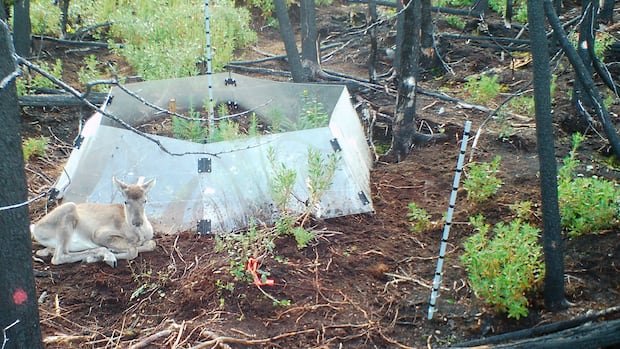

A wildfire researcher in Newfoundland, Lucas Brehaut, is facing challenges as local wildlife disrupts his forest regeneration study post wildfires. Brehaut, a scientist with the Canadian Forest Service, is investigating forest regrowth in Atlantic Canada post wildfires, a region experiencing an increase in forest fires despite its cooler and wetter climate. Following a forest fire near Grand Falls-Windsor in 2022, Brehaut initiated a study on forest regeneration amid rising temperatures due to climate change. His team installed 19 open-top chambers (OTCs) resembling mini greenhouses to simulate temperature increases of one to three degrees, crucial for mimicking a warmer planet’s effects. Now in the third year of a five-year study, Brehaut’s research faced unexpected challenges in September 2023 when various wildlife, including caribou, moose, black bears, rabbits, coyotes, and owls, interfered with the research equipment, causing damage and relocating temperature sensors. Despite setbacks, Brehaut remains understanding, acknowledging the animals’ natural curiosity and behavior in their habitat. Kaitlyn Gaynor, a University of British Columbia professor, explains that animals’ curiosity towards novel objects is innate, driven by the potential for food sources or perceived threats. She emphasizes the importance of minimizing human scent on equipment to reduce wildlife interference. Animal disruptions in research are a global occurrence, as observed by Gaynor during her fieldwork in Mozambique, where baboons, hyenas, and elephants have been notorious for interfering with research equipment. While animals pose challenges, Brehaut notes that human activities, such as accidental damage by snowmobiles, also impact his research sites.

Established in 2015, Vatican City Post is a professional and independent news portal committed to delivering accurate, balanced, and timely information. Covering global affairs, religion, culture, and current events, we strive to uphold the highest standards of journalism with integrity, transparency, and professionalism.
© Vatican City Post | All rights reserved.