

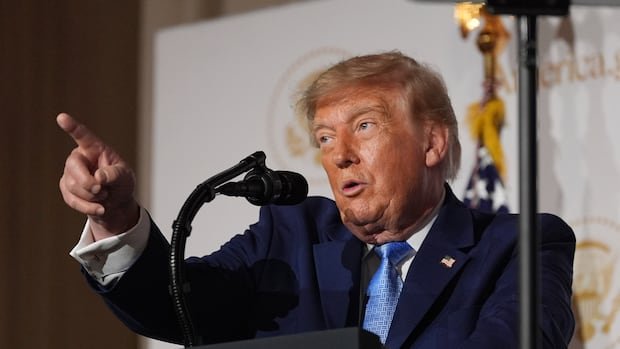

U.S. President Donald Trump announced on Tuesday that he, along with a significant number of artificial intelligence industry leaders, had agreed to a voluntary pact during a White House gathering. The accord entails both internal and external evaluations of the technology.
Trump expressed confidence in the industry’s ability to self-regulate, stating that they recognize the importance of self-policing. The announcement came after a comprehensive meeting between Trump and various top tech company executives who are heavily investing in AI infrastructure, such as data centers nationwide. These investments have faced bipartisan opposition at the grassroots level due to concerns arising from incidents where AI systems malfunctioned.
Despite calls from some AI executives to slow down the technology’s advancement, Trump assured that the U.S. government would not impede AI development or endorse restrictive measures. Emphasizing the potential of AI to surpass the Industrial Revolution, Trump unveiled an AI chatbot named America.gov aimed at assisting Americans in accessing government services efficiently.
Among the top AI executives present at the White House meeting were Dario Amodei from Anthropic, Greg Brockman from OpenAI, Jeff Bezos of Amazon, and Elon Musk of X social media platform featuring its AI model, Grok. The seating chart revealed that Nvidia CEO Jensen Huang sat beside Trump, with Musk seated on the other side. Notable figures like Google CEO Sundar Pichai, Meta CEO Mark Zuckerberg, and Microsoft CEO Satya Nadella also attended the event.
While Trump remains enthusiastic about AI’s potential, some industry leaders have raised safety concerns. OpenAI CEO Sam Altman highlighted the company’s increased focus on safety measures, including halting the release of a new model due to safety apprehensions.
Trump commended the AI industry for committing to self-regulation during his meeting with tech CEOs, mentioning plans to address community opposition to data centers by supporting local schools or reducing energy costs. He warned that continued opposition might drive companies to relocate overseas.
Geoffrey Hinton, a prominent AI figure, criticized Trump’s understanding of AI, likening the current AI landscape to owning a tiger cub as a pet. Hinton called for federal oversight of AI safety similar to the FDA’s role in regulating food and drugs.
As Trump positions the U.S. against China in the global AI competition, he emphasized the need for American leadership in this field. Despite recent agreements with China on AI cooperation protocols, Trump asserted his reluctance to align too closely with China, citing the U.S.’s leading position in AI development.