

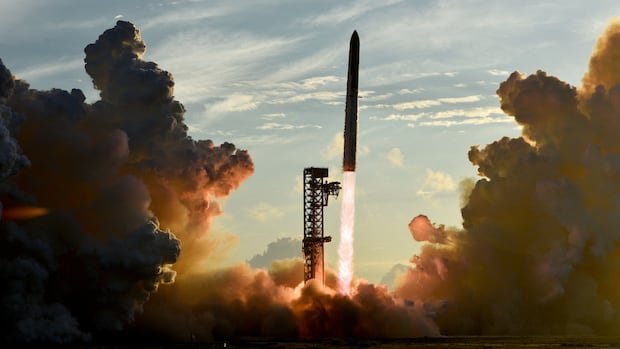

SpaceX successfully launched its massive Starship into orbit for the first time on Monday, delivering the most advanced Starlink satellites to date before ending the flight prematurely in the Pacific Ocean after over three hours. Originally targeting a 10-hour flight for NASA’s Artemis moon program, the spacecraft faced initial engine shutdown issues post-liftoff. However, with the malfunctioning engine no longer critical and all other systems functioning well, SpaceX proceeded with the mission.
Elon Musk’s groundbreaking rocket, the largest and most powerful ever constructed, carried 26 cutting-edge Starlink satellites to supplement the existing 11,000 models providing internet services. The satellites were deployed successfully, eliciting cheers from spectators at the Starbase launch site in Texas.
The decision to curtail the flight was made shortly after the satellite deployment, with no specific reason provided. This marked Starship’s 14th full-scale launch from southern Texas in three years, with previous tests only reaching the Indian Ocean. The objective was to complete six orbits around the Earth at an altitude of 275 kilometers, but caution led to an early return after just a few laps.
SpaceX’s priority is safety and operational efficiency, as seen in the deliberate landing of the first-stage booster in the Gulf of Mexico instead of returning to the launch site. Musk emphasized the importance of cautious operations to maintain public trust and avoid accidents like previous debris incidents.
Pending the evaluation of Monday’s mission, SpaceX plans to bring back the next Starship using giant mechanical arms for a mid-air catch, aiming for a reflight by the end of the year. The rocket’s reusability is central to cost reduction strategies.
SpaceX aims to certify Starship for orbital flight, a crucial milestone for future missions to the moon and Mars. With NASA’s Artemis III mission approaching, SpaceX is gearing up for complex orbital exercises involving lunar landers and astronaut missions. The company’s long-term vision includes regular moon and satellite missions using Starship, gradually phasing out older rocket models.
Musk’s ambitious plans for Starship encompass not only Mars exploration but also key roles in lunar missions and satellite deployment activities. Expansion plans include additional launch sites in Florida and Louisiana to support growing space endeavors.