


Two individuals who previously organized the annual vigil in Hong Kong to commemorate the 1989 Tiananmen Square crackdown have been found guilty in a national security case. The charges were brought under a law imposed by China that has significantly impacted the city’s pro-democracy movement. Lee Cheuk-yan and Chow Hang-tung, former leaders of the Hong Kong Alliance in Support of Patriotic Democratic Movements of China, faced allegations of inciting subversion under the national security law in 2021. Despite pleading not guilty, they now face a potential maximum prison sentence of 10 years, with the alliance also being convicted.
The judges determined that the alliance’s advocacy to “end one-party dictatorship” was not merely a call for the ruling Communist Party to return to a system of multiparty cooperation as outlined in the constitution. Instead, they interpreted the phrase “end” as implying “overthrowing” and “undermining.” The defendants were accused of persisting in their advocacy even after the law’s implementation, disregarding that it contravened the constitution, which designates the party’s leadership as a fundamental aspect of socialism with Chinese characteristics. This action was considered as falling within the scope of “other unlawful means” under the security law.
The outcome of this case is part of a broader trend in Hong Kong where the pro-democracy movement, once vibrant, has been significantly curtailed by local and Chinese authorities. The annual candlelight vigil organized by the alliance, which used to draw tens of thousands of attendees to mourn the victims of the Tiananmen Square incident, was banned in 2020 due to the COVID-19 pandemic. Shortly after, the security law was imposed by Beijing to suppress the large-scale anti-government protests that occurred in 2019.
Lee and Chow, who smiled and waved at the public gallery as they left the courtroom, are awaiting sentencing. Observers view their trial as emblematic of the diminishing freedom of expression in the former British colony since its handover to Chinese rule in 1997. The judges have not disclosed the detailed rationale behind the conviction, indicating that the full judgment will be available online at a later date.
A senior fellow at the Georgetown Center for Asian Law, Eric Lai, remarked that the charge of inciting subversion, commonly used in mainland China to target human rights advocates, reflects a concerning alignment of the Hong Kong judiciary with the party-led legal system in China. The accused were charged with inciting the overthrow of China’s ruling party, with prosecutors asserting that the case was not politically motivated but focused on the alleged incitement to overthrow the Communist Party’s leadership through unlawful means.
During the trial, Lee argued that the call to “end one-party rule” was about advancing democracy and allowing the people to choose their leaders, rather than advocating for the removal of the party’s leadership. Chow, who represented herself, contended that “ending one-party rule” aimed to dismantle unchecked power and criticized the reversal of the moral standard in the case.
The trial, initially scheduled for 75 days, concluded much sooner, with closing statements wrapping up on the 24th day. Albert Ho, another defendant who pleaded guilty at the start of the trial, may receive a reduced sentence as a result. Lee and Chow are expected to seek leniency during a subsequent hearing and could potentially be sentenced alongside Ho.
Following the conviction, Lee’s wife expressed disappointment and anger, emphasizing her belief in Lee’s innocence. She criticized the judges for allegedly disregarding the defense’s arguments and materials and indicated that they would consider appealing the verdict.
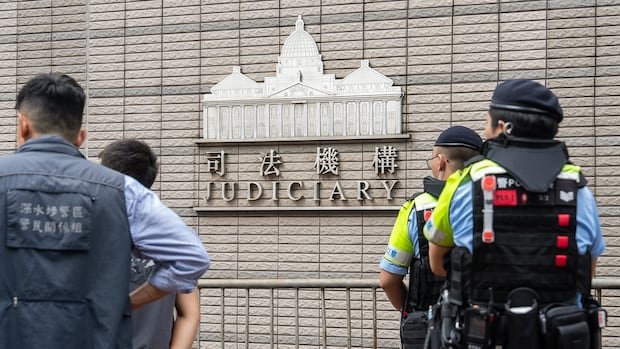
Supporters of the defendants gathered outside the court before the hearing, with one former alliance member highlighting restrictions placed by the police on bringing certain materials into the court premises. The potential guilty verdict for the alliance was described as challenging their understanding of the city’s legal framework.
The 1989 Tiananmen Square crackdown, during which hundreds, possibly thousands, lost their lives as the military intervened, marked a significant turning point in China’s modern history. It underscored that economic reforms leading to China’s emergence as a global economic power did not coincide with political liberalization. In the aftermath of the COVID-19 restrictions, the former vigil site in Hong Kong was replaced by a carnival organized by pro-Beijing groups. The Beijing government justified the imposition of the security law in 2020 as essential for the city’s stability, resulting in the imprisonment of numerous prominent activists under the same legislation, including media mogul Jimmy Lai. The political landscape in Hong Kong has witnessed drastic changes, with the dissolution of multiple civil society organizations, including the alliance.