

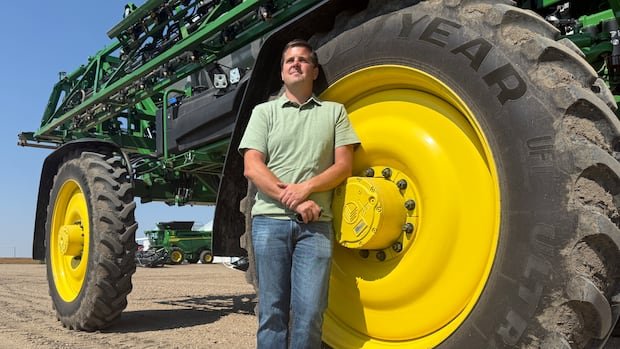

In Coleville, Saskatchewan, Dean Roberts observed a large grey drone taking flight over his expansive 4,000-hectare farm that cultivates various crops like canola, wheat, barley, and lentils. The demonstration showcased the DJI T100, the largest spray drone currently available in Canada, equipped with a 100-liter tank for spraying pesticides on crops, a practice recently approved by the federal government.
During the demo, the drone’s tank was filled with water as it maneuvered through the fields. Roberts explained how this technology could benefit his farm operations, particularly in situations where wet conditions make it challenging for traditional ground rigs to apply necessary treatments to the crops.
Roberts emphasized that Prairie farmers like him have a history of embracing technological advancements to enhance crop yields. However, he noted that Canada lags behind other countries like the U.S., China, Brazil, Japan, and Australia in allowing drone spraying for agriculture.
Regulatory constraints have been a barrier to adopting agricultural technology in Canada, according to Roberts. Factors such as bureaucratic red tape, infrastructure limitations, and labor shortages have been inhibiting Canada’s competitive edge in global food exports compared to other nations.
Despite Canada’s annual export value of around $100 billion in agri-food products, its growth rate has not matched that of other countries. Evan Fraser, from the University of Guelph, highlighted the need for Canada to streamline regulatory processes and invest in infrastructure to boost its food export capabilities.
Roberts raised concerns about the logistical challenges in transporting crops to global markets, especially relying heavily on railways for export. Infrastructure bottlenecks and delays in rail transportation can lead to significant setbacks for farmers like Roberts, impacting their ability to deliver crops to ports efficiently.
Evan Shout, a farming industry expert, echoed Roberts’ concerns about infrastructure limitations affecting the agricultural sector, emphasizing the need for better infrastructure investments to support farmers. He also highlighted the challenges in finding skilled labor for farming operations, especially during critical seasonal tasks.
In response to these challenges, Agriculture Minister Heath MacDonald affirmed the government’s commitment to addressing obstacles hindering farmers and enhancing opportunities for Canadian agri-food exports through various initiatives and infrastructure investments.
The national food security strategy aims to reduce red tape and boost domestic food production to lower costs for Canadians while also exploring opportunities to expand export capacity. However, Jennifer Clapp, a sustainability expert, cautioned that Canada should focus on sustainable agricultural practices and consider the implications of aggressively expanding export markets on global food security.
Fraser emphasized the need for Canada to position itself as a significant agricultural player, leveraging climate change impacts to enhance productivity. While Roberts believed in Canada’s potential to contribute significantly to global food production, he acknowledged the challenges in fully meeting the world’s food needs.