

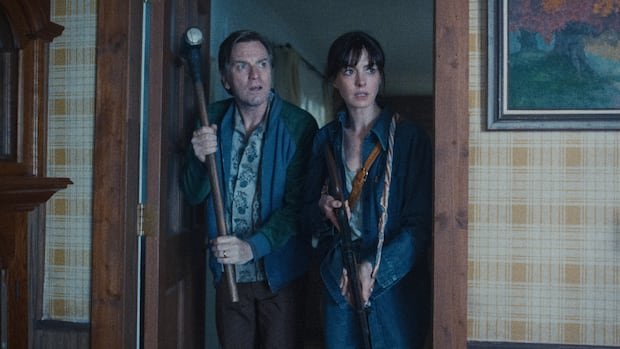

In 1982, housewives faced various concerns. Whether it was their children engaging in teenage antics or facing neighborhood bullies, dealing with a distant spouse, peculiar blue lights, intense heat, and even a mysterious dinosaur tail in the backyard added to their worries. The story of Oak Street, as portrayed by housewife Denise (Anne Hathaway) and director David Robert Mitchell in “The End of Oak Street,” unfolds in a neighborhood transported back to the late Jurassic era. The narrative follows a family’s struggles with both external creatures and internal conflicts.
The Detroit family, including the aloof yet caring father Greg (Ewan McGregor), the talented but despondent elder sister Audrey (Maisy Stella), and the boy-next-door younger brother Brian (Christian Convery), embodies a quintessential American family dynamic. The film captures a Spielbergian essence blended with a Stephen King-like atmosphere, offering a nostalgic 80s adventure craved by audiences fatigued with somber films.
Despite being touted as the summer blockbuster, “The End of Oak Street” falls short of its anticipated success. While it attempts to emulate classic Spielberg films, it lacks the depth and artistic essence that made those movies iconic. The film’s focus on dinosaurs and time travel lacks the thematic richness and character development found in its inspirations.
The movie’s brief runtime and sluggish character development leave little room for meaningful storytelling, resulting in repetitive action sequences and underdeveloped characters. The dinosaur attacks, while visually engaging, fail to sustain interest due to the absence of substantial character growth and narrative depth. The film’s reliance on nostalgic visuals and themes without offering a fresh perspective raises questions about its artistic merit.
While “The End of Oak Street” may appeal to viewers seeking spectacle and nostalgia, its lack of a compelling narrative and character arcs may leave some audiences wanting more. The film’s homage to Spielberg’s work feels more like imitation than innovation, highlighting the challenges of creating a meaningful cinematic experience in a saturated market.