

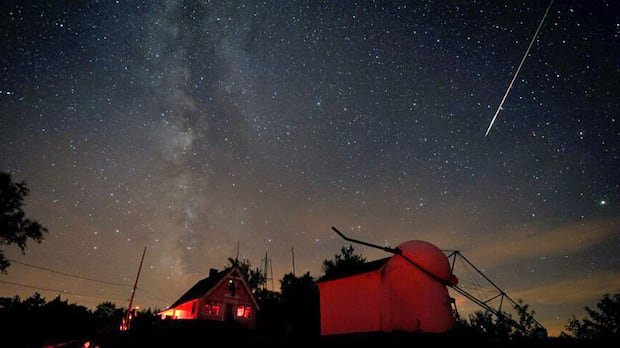

August brings one of the most spectacular meteor showers of the year, the Perseids, alongside a partial solar eclipse. The Perseids are renowned for their abundance and brightness, making it a favorite among stargazers due to optimal viewing conditions. This year’s peak falls on Aug. 12-13, coinciding with a new moon, ensuring a moonlight-free sky for a better view.
Renowned meteor astronomer Peter Brown anticipates a vibrant display of Earth-grazers during this year’s Perseids, describing them as bright and fast, creating a spectacular sight. The shower is expected to peak around midnight Eastern Daylight Time, potentially showcasing up to 120 meteors per hour, although this assumes ideal dark-sky conditions.
Meteor enthusiasts are encouraged to venture out early for the best viewing experience, with the shower starting around 10 p.m. or even earlier. The radiant point of the Perseids lies in the Perseus constellation, visible low in the eastern sky after sunset, with meteors streaking across the entire celestial dome.
In addition to the Perseids, other meteor showers like the southern delta Aquariids and alpha Capricornids are also active, offering additional opportunities to witness shooting stars. The upcoming partial solar eclipse on Aug. 12 will be visible in Greenland, Iceland, Spain, and a small part of Portugal, presenting a unique astronomical event for observers in those regions. While Canada won’t experience a total eclipse, a partial eclipse will still be visible, with the extent varying depending on location.
Observing a solar eclipse requires caution, necessitating the use of approved solar eclipse glasses to protect the eyes. Astronomers emphasize the educational value of solar eclipses, showcasing the dynamic interactions between the Earth, moon, and sun.