

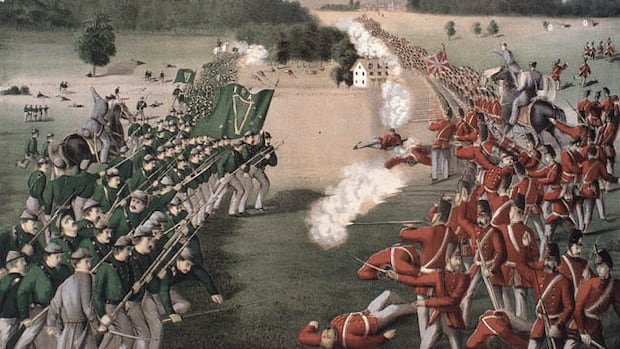

An overlooked clash on Canadian land just before Confederation may not resonate with most Canadians beyond Fort Erie, Ont., but it holds significance in various historical aspects. The 1866 Battle of Ridgeway, the first Canadian-led battle by Canadian officers, served as the catalyst for Decoration Day, a precursor to Remembrance Day still observed in some regions. Despite this, the nine soldiers who perished in the battle are absent from the Books of Remembrance, a collection on Parliament Hill honoring fallen Canadian soldiers.
A new petition, to be presented in the House of Commons, aims to include these nine soldiers and the numerous casualties post-battle in the official remembrance list. Conservative MP Fred Davies, representing the Niagara South riding including Fort Erie, emphasized the importance of recognizing those who perished defending Canada.
The Battle of Ridgeway was not a resounding Canadian triumph, as inexperienced volunteers confronted seasoned Fenian raiders, mostly American Civil War veterans. The Fenian Brotherhood, an Irish American movement, sought Irish independence from British rule by invading and occupying parts of British North America. In 1866, hundreds of raiders crossed the Niagara River, aiming to strike the Welland Canal, only to encounter around 800 Canadian volunteers at Limestone Ridge near Ridgeway and Fort Erie.
Historian Peter Vronsky noted the rapid mobilization of Canadians from the Golden Horseshoe region, despite their inadequate preparation for what he described as Canada’s first modern battle. The Canadian troops faced challenges such as lack of supplies and ammunition, leading to a somewhat disorganized retreat following a Fenian attack. Nevertheless, the Canadians managed to repel the invaders, forcing them to retreat to the U.S. side of the Niagara River.
While the Battle of Ridgeway ended in a battlefield defeat, it did not diminish the sacrifice of those who fought for Canada’s defense. Davies stressed the significance of honoring these fallen individuals, regardless of the battle’s outcome. A memorial commemorating the nine fallen soldiers was erected in 2016, but efforts to include their names in the Books of Remembrance have been unsuccessful.
The battle’s impact on Confederation was highlighted by Redekop, Davies, and Vronsky, with Vronsky suggesting that it played a pivotal role in shaping Canada’s identity. Several regiments involved in the 1866 battle, including the Queen’s Own Rifles and the Royal Hamilton Light Infantry, continue to exist today, symbolizing the foundation of Canada’s modern armed forces.
Alexander Muir, who fought at Ridgeway, composed “The Maple Leaf Forever,” a patriotic song that may have drawn inspiration from the maple leaf emblem of the Queen’s Own Rifles. Vronsky pointed out that the battle marked a shift where Canadians fought for their communities first and allegiance to the crown second.