

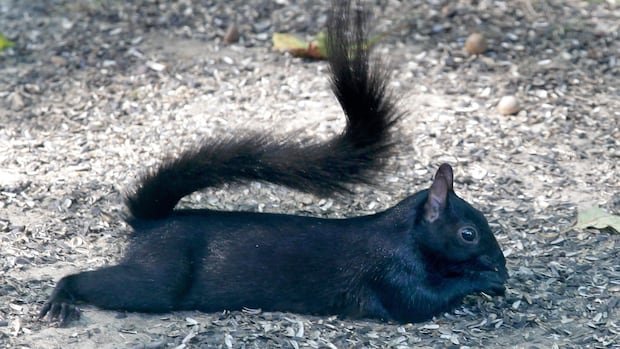

Francis Quang-Hai Dinh spent his first summer at McGill University exploring Montreal’s parks on his bicycle, on a mission to study the squirrel population. He meticulously documented over 800 grey and black squirrels across nearly 200 green spaces stretching from Mirabel to Saint-Bruno. What initially began as a university assignment morphed into a personal initiative to investigate how the city’s layout and water systems influence evolution.
Dinh, who is currently pursuing integrative biology at the University of Illinois Urbana-Champaign, became enamored with squirrels after closely observing them and realizing their significance as wildlife. Due to limited public transportation options in suburban areas, Dinh relied on his bike to travel extensively, making him the sole researcher known to manually survey squirrels park-by-park throughout the region.
His findings revealed that the percentage of black squirrels in Montreal varies, with approximately 12% being black on average. As he ventured further north, the prevalence of black squirrels increased significantly. In regions just north of Laval, up to 40% of squirrels were black, while on the island of Laval, around 20% exhibited this coloration. Conversely, on the island of Montreal and the south shore, the proportion of black squirrels dropped to 15% and 2-3%, respectively.
The study attributed these variations primarily to temperature, with cooler climates favoring black squirrels due to their superior heat absorption capabilities. Additionally, the density of forest cover played a role, as darker backgrounds provided better camouflage for black squirrels.
Allison Roth, the study’s senior author and an assistant professor at the University of Missouri, emphasized that the research focuses on using squirrels as a model to explore how urban environments drive evolutionary changes. Cities like Montreal, segmented by waterways like the St. Lawrence River, create distinct environmental conditions that foster genetic and physical adaptations in animal populations.
The study, titled “Fine-scale spatial variation in eastern grey squirrel melanism across a complex urban landscape,” emphasizes the importance of considering neighborhood-specific wildlife changes within cities. While urbanization impacts local temperature and vegetation, natural barriers like riverways also influence evolutionary patterns. The research is part of a special feature by ecology journals examining collaborative approaches to addressing ecological questions.
Dinh reflected on his profound shift in perspective, recognizing the coexistence of wildlife and urban environments. He highlighted the resilience of wildlife in adapting to human modifications, emphasizing the interconnectedness of nature and city life.