

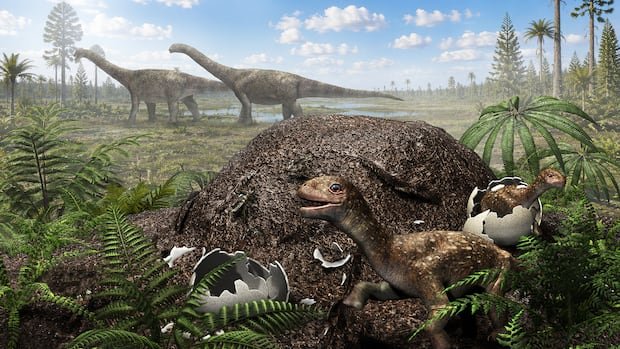

A recent discovery has unveiled fossil eggshells believed to belong to some of the largest dinosaurs ever known, found in a cooler climate far from the equator. Despite the colossal size of the titanosaurs, they did not incubate their volleyball-sized eggs by sitting on them, as they were too massive for that practice. Instead, a new study by University of Calgary paleontologist Darla Zelenitsky and researchers from Japan and Argentina suggests that titanosaurs likely utilized a method similar to modern crocodiles to keep their eggs warm for hatching.
The study delved into the microscopic details of the eggshells, revealing that titanosaurs probably buried their eggs in warm piles of decaying vegetation, a technique commonly observed in crocodiles. Titanosaurs, massive plant-eating dinosaurs with long necks and tails, weighing up to 75 tonnes, existed during the Late Cretaceous period, just before the extinction of dinosaurs. These dinosaur giants roamed a lush coastal ecosystem in what is now southern Argentina, alongside various other dinosaur species, crocodiles, snakes, turtles, and mammals.
The fossilized eggs, known as Fusioolithus, previously discovered in warmer climates, were found in the Chorrillo Formation in southern Argentina in 2020 and 2024. This finding was surprising, considering the distance from the equator and the challenges associated with reproducing and surviving in such environments. The eggs, with their microscopic pores for breathing, needed to be kept warm for months for the embryos to develop and hatch.
The research sheds light on the adaptability of dinosaurs, showcasing how even the largest among them found innovative ways to reproduce and nest in various environments. The discovery of titanosaurs’ nesting habits in a cooler climate emphasizes the diverse strategies employed by different dinosaur species for egg incubation. This study underscores the remarkable abilities of dinosaurs to thrive in challenging environments, providing valuable insights into their reproductive behaviors and adaptations.