


On Thursday, rescue teams were actively searching for hundreds of individuals reported missing along the Nepal-Tibet border, following a devastating surge of water and mud that struck local communities a day prior due to a glacier collapse.
According to reports from authorities in both Nepal and China, The Associated Press indicated that over 390 fatalities have been confirmed and more than 1,400 individuals are unaccounted for. In contrast, Reuters reported at least 359 deaths with nearly 1,000 people missing, including nationals from various countries worldwide, as a result of the flash floods that occurred on Wednesday morning local time.
Anita Anand, the Foreign Affairs Minister, stated that the government is “aware of 30 Canadians and permanent residents currently in Nepal and Tibet whose safety and location remain unverified.” She emphasized that this number may fluctuate due to the challenging conditions on the ground, which include difficulties in communication.
A family member of Dhaval and Megha Shah confirmed that the couple from Port Moody, B.C., is among the missing Canadians.
Nikita Shah, Dhaval’s cousin, mentioned that the couple was on a “spiritual journey” in Nepal and that the last communication from them was received on Tuesday night.
Shah added that the couple was lodging at Hotel Kailash.
“We have no way of knowing if the infrastructure is still intact, as we receive a lot of misinformation, so it would be extremely helpful if the Canadian government could assist,” said Shah. “The Canadian government must take action regarding this situation.”
Global Affairs Canada announced that it is deploying five consular officials to Kathmandu to assist Canadians and collaborate with local authorities.
“In addition to working closely with counterparts in Nepal and China, we are also liaising with international partners and allies that have citizens in the affected area,” the statement read.
The Nepal Tourism Board, which has shared information about those missing from various countries, previously reported that 25 Canadians were among the unaccounted.
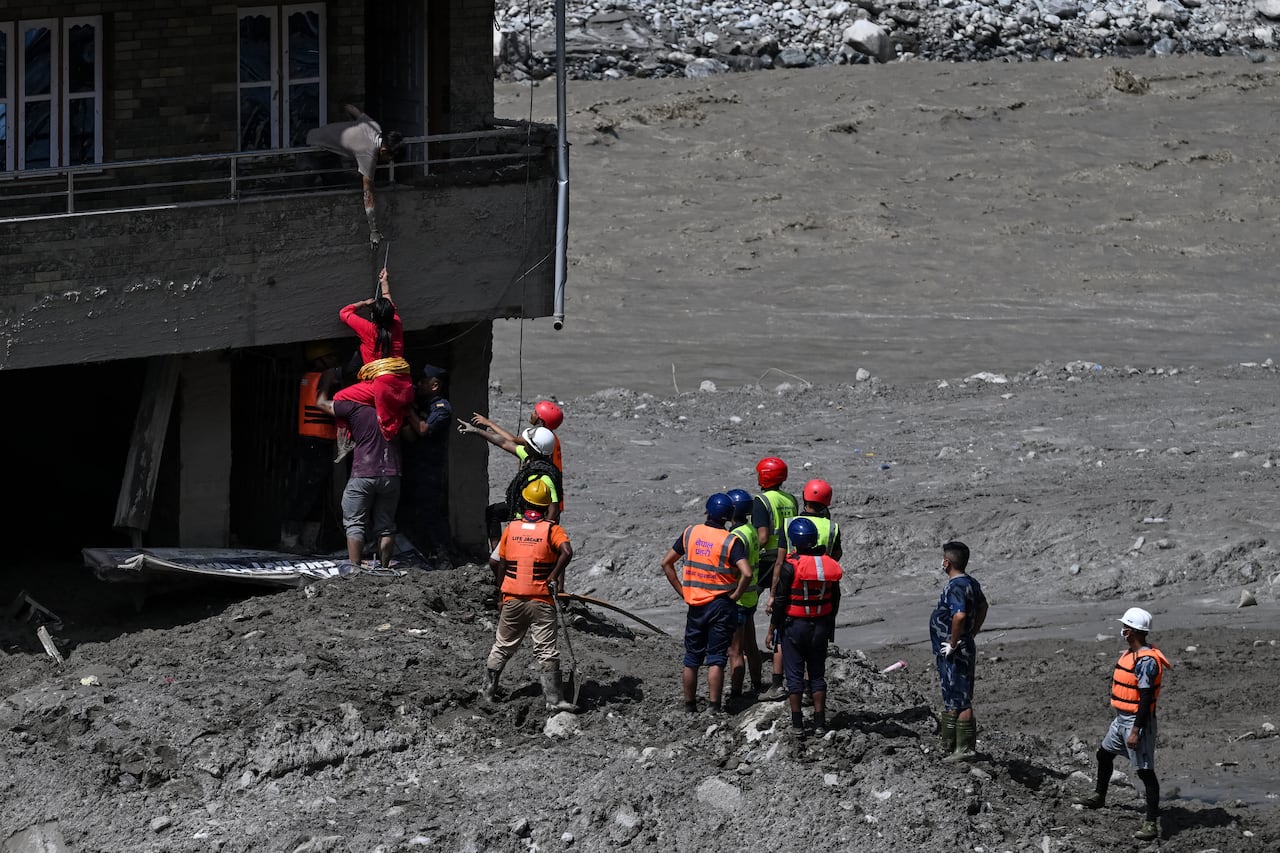
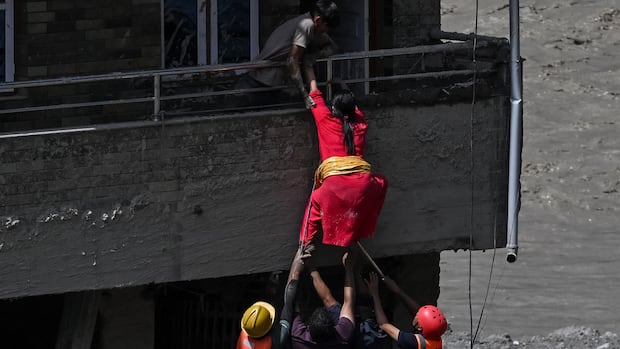
Police personnel rescue stranded residents from houses lying deluged in sludge after flash floods at Trishuli in Nepal’s Nuwakot district on Thursday. (Arun Sankar/AFP/Getty Images)
The steep valleys in the region serve as crucial economic routes and travel corridors but become perilous during disasters. Images revealed the upper levels of buildings in Nuwakot covered in mud after the torrent swept through. Debris was caught in tree branches and wires, vehicles were buried, and some shocked survivors were coated in mud.
“When I arrived at Dhunge bazaar, within half an hour, the flood came and destroyed the entire market. People were getting ready to go to work at that time,” reported resident Shoyam Rajbhandari. “We are unaware of how many people are missing or deceased.”
UN activates rescue fund
On Thursday, Tom Fletcher, the UN’s humanitarian chief, announced the allocation of $2 million US from the UN’s Central Emergency Response Fund to assist with medical care, shelter, and water supplies.
Fletcher also stated that emergency teams have been deployed, with additional teams on standby.
The majority of the fatalities and 826 of the missing individuals were reported in Nepal, while three deaths and 558 missing were noted in Tibet, according to officials. The Nepal Tourism Board indicated that 517 of those unaccounted for in Nepal were foreigners, with 178 from India.
-
Flash floods kill more than 160 in Nepal, Tibet
-
Video
Hundreds of people, including tourists, missing after flood in Nepal
Moreover, Lin Jian, a spokesperson for China’s Ministry of Foreign Affairs, stated that nearly 100 Chinese citizens were unaccounted for on the Nepal side.
Officials in Nepal reported that numerous bridges were destroyed and nearly 40 kilometers of roads were damaged, hindering search and rescue efforts.
The Nepalese army reported that more than 100 individuals have been rescued from flood-impacted areas through helicopter operations as of Thursday morning, according to army spokesperson Brig. Gen. Raja Ram Basnet.
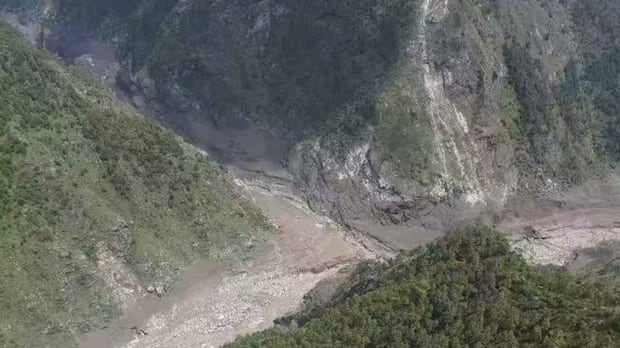
An entire river valley along the Nepal border was wiped out in seconds… but local radar showed no rain, and it wasn’t an earthquake. CBC Meteorologist Johanna Wagstaffe breaks down how a massive glacier collapse triggered a violent inland tsunami—and why geologists warn this unfolding climate disaster isn’t over yet.
At least eight foreign nationals were transported by air to Kathmandu, he mentioned, adding that army teams also rescued individuals trapped in facilities related to the Trishuli hydropower project.
Rescue teams discovered bodies approximately 100 kilometers downstream from the disaster site in Chitwan district. Numerous injured individuals have been moved to Kathmandu for more advanced medical treatment.
Bishal Kumar Bhandari, the chairman of the Nepal Red Cross Society, indicated that their focus has shifted from rescue efforts to large-scale relief initiatives in the flood-stricken areas. He reported that around 1,200 individuals have been displaced from at least three villages.
In Tibet, a mudslide that occurred near the Gyirong Port land border crossing on Wednesday left areas with mud deposits averaging over 1.5 meters deep, and some sections of roads exceeding two meters, as reported by Chinese state broadcaster CCTV. All roads leading to the port sustained damage, and secondary collapses or landslides could happen as rainfall persists in the area.
Increasingly common glacier melting
The U.S. Geological Survey (USGS) initially reported a magnitude 4.4 earthquake early Wednesday, roughly 66 kilometers north of Kathmandu, close to the border.
The USGS later revised its assessment, stating that the seismic event was actually a magnitude 5.2 glacier collapse that sent debris downstream, devastating local communities. This conclusion was based on data collected from nearby seismic stations, long-period seismic waves, and satellite imagery, clarifying that no earthquake took place.
Experts on climate from the International Centre for Integrated Mountain Development in Kathmandu suggested that the flash flood on Wednesday was likely caused by an avalanche from a glacier.
“Hydrological data demonstrates the remarkable speed and magnitude of the flood wave,” they stated in an email, pointing out that water levels at a certain point on the Trishuli river surged by as much as nine meters in just half an hour.
They noted that the Lhende Khola River, a tributary of the Bhotekoshi, experienced the highest levels of flooding.
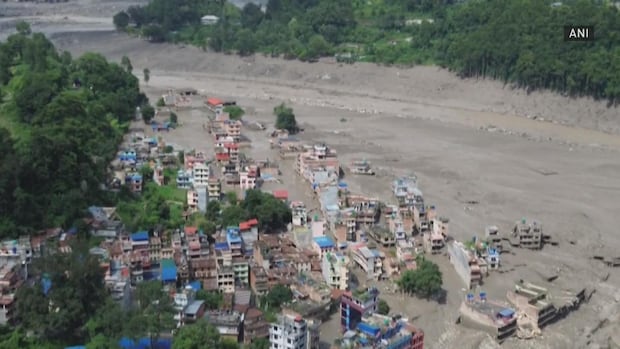
Video captured by a drone shows the impact of floodwaters in parts of Nepal’s Nuwakot district, where some riverside buildings were left surrounded by mud.
The steep inclines and fertile valleys beneath the Himalayan range, which traverse several Asian nations, are particularly susceptible to flooding and landslides. The phenomenon of melting glaciers has intensified due to climate change driven by human activities.
Researchers in Kathmandu discovered earlier this year that glaciers in the Hindu Kush Himalaya region are melting at an accelerated pace, with ice loss rates doubling since the year 2000.
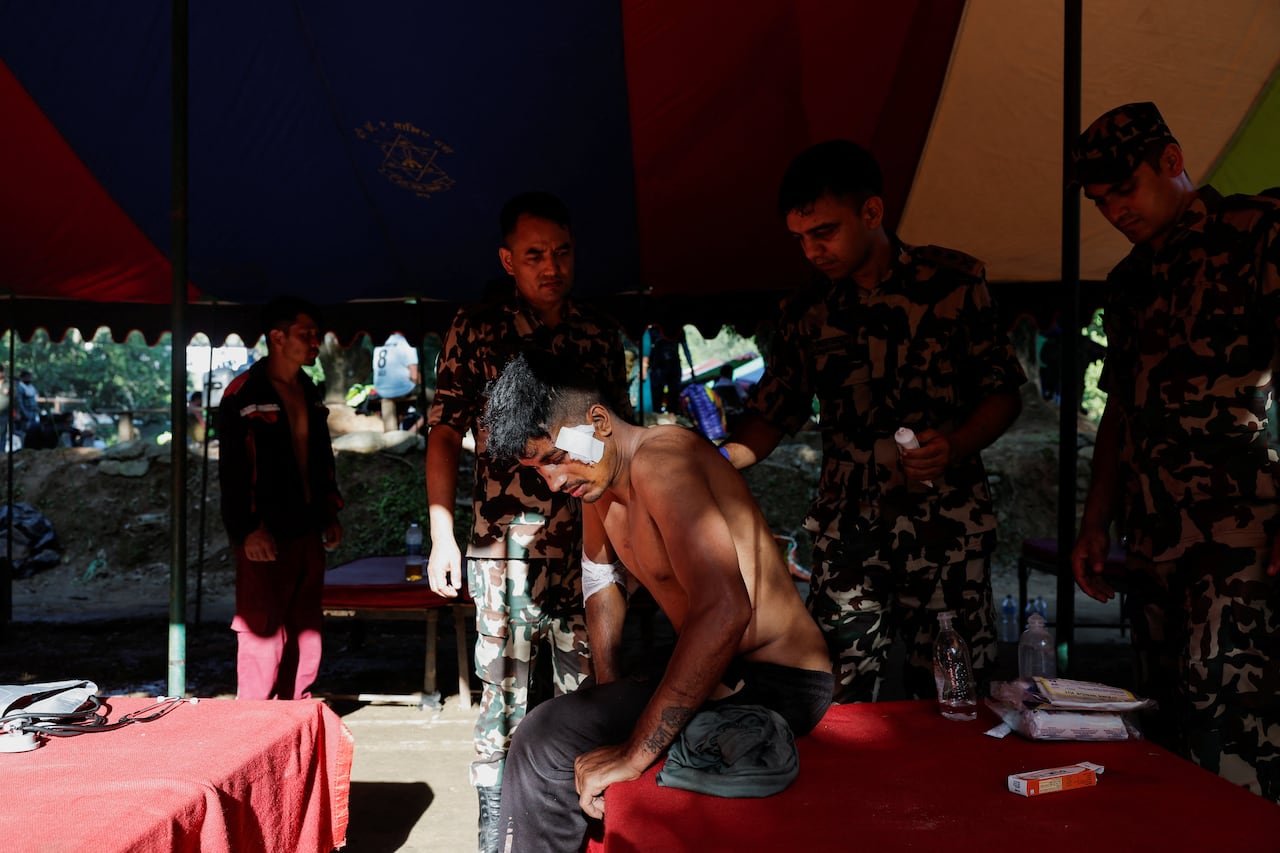
A man who was airlifted from Rasuwa district receives first aid at a mobile hospital staffed by army personnel in Trishuli, in Nuwakot district, Nepal. (Navesh Chitrakar/Reuters)
Tag: rewrite-pending