

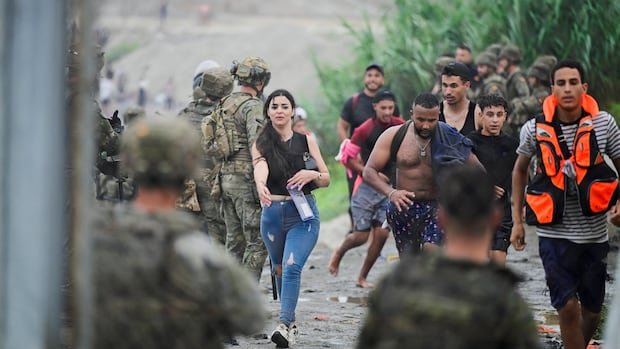

Spain and Morocco have strengthened the border fence of a Spanish enclave, effectively reducing mass crossings following the influx of tens of thousands of people by sea and land in a single day. Reports confirm that at least 57 individuals have lost their lives after approximately 60,000 individuals entered Ceuta over the past days. By 6 p.m. local time on Friday, an estimated 48,300 migrants had voluntarily returned to Morocco, as stated by Spain’s Interior Ministry.
The surge of migrants into Ceuta, a small Spanish-held peninsula extending into the Mediterranean from Morocco, has caused concern and division in Europe. France announced heightened border checks with Spain, while Italy threatened to suspend Spain from the European Union’s internal open border system. Moroccan authorities at the Ceuta gates deployed water cannon trucks to deter crossings, resorting to batons and tear gas to prevent further incursions.
Spanish authorities aim to swiftly expel those who entered unlawfully, despite a court ruling imposing restrictions on immediate expulsions under special “border rejection” regulations. Prime Minister Pedro Sanchez emphasized the violation of Spain’s territorial sovereignty due to the mass crossings and urged Morocco to intensify efforts to control the outflow of people.
Ceuta and Melilla, another Spanish autonomous city in northern Morocco, represent the European Union’s sole land borders with Africa. Both cities, each home to around 85,000 residents, periodically witness spikes in attempted migrant crossings, with Thursday’s surge being unprecedented in scale. Various factors, including a recent ruling by Spain’s Supreme Court prohibiting summary returns of migrants intercepted at sea en route to Ceuta or Melilla, likely contributed to the sudden increase.
Migrants often swim from the Moroccan town of Fnideq, covering approximately five kilometers to reach Ceuta on the North African coast. Despite reinforced security preventing most crossings, groups maneuver along the coast seeking alternative routes around the fence, with some preparing to swim. The deployment of insufficient police during Thursday’s surge, as noted by Spain’s Guardia Civil police association AUGC, hindered the control of the situation.
Migration remains a sensitive topic in Europe, particularly with the rise of right-wing parties post the 2015 crisis when over a million individuals traversed the continent seeking asylum, primarily fleeing conflict in Syria. To address the current situation, French Interior Minister Laurent Nunez announced a fivefold increase in police presence on the Spanish border, along with enhanced aerial surveillance and train patrols.
While the EU’s internal Schengen Area typically maintains open borders among member states, temporary checks can be implemented under exceptional circumstances. German Chancellor Friedrich Merz expressed support for Spain’s commitment to prevent illegal migrant entries onto European soil. Italy’s Prime Minister Giorgia Meloni affirmed readiness to take extraordinary measures to safeguard borders and citizens, including considering suspending the Schengen Area with Spain.
Amidst these developments, President Donald Trump of the U.S., a vocal critic of Spain’s Socialist-led government, likened the Ceuta crossings to an “invasion.” Spain’s Socialist administration remains resolute on addressing illegal crossings, emphasizing the economic benefits immigrants bring, supported by long-term data. The government’s mass amnesty initiative, which attracted hundreds of thousands seeking citizenship, underscores its stance on immigration despite recent challenges.
Italy’s Foreign Minister Antonio Tajani criticized Spain’s citizenship grant to irregular immigrants, accusing it of fostering human trafficking. In response, Spain’s Foreign Minister Jose Manuel Albares denounced Tajani’s comments as inappropriate, calling for solidarity rather than political posturing from partner countries. Albares indicated the intention to summon the Italian ambassador to express Spain’s objection.
These events reflect the complex dynamics surrounding migration and border security in the European context, prompting varied responses and calls for coordinated action within the EU.