

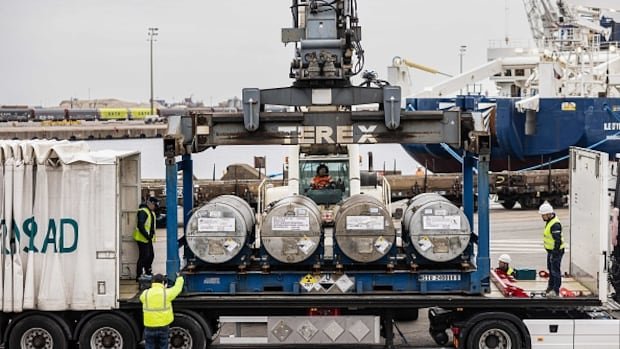

Amidst the ongoing conflict between Russia and Ukraine, where Russian forces have seized Ukraine’s largest nuclear plant and targeted its power infrastructure, it has come to light that Europe and the United States still rely on Russian nuclear fuel to operate their electricity grids.
One of the recipients of low enriched uranium (LEU) from Russia for commercial nuclear reactors in the U.S. is Canadian-owned Westinghouse Electric, as indicated by shipping data analyzed by CBC’s investigative program, the fifth estate. While the U.S. had banned the import of Russian enriched uranium in August 2024 to reduce dependence on Russian materials, waivers under the Prohibiting Russian Uranium Imports Act allowed for exceptions until January 1, 2028, if alternative sources of LEU were unavailable or if import was deemed in the national interest.
In 2025 alone, the U.S. reportedly imported 400 tonnes of low enriched uranium from Russia, valued at approximately $1 billion US, with major recipients including subsidiaries of Framatome, Global Nuclear Fuel Americas, and Westinghouse. Despite the ban in the U.S., the European Union has not restricted the import of Russian enriched uranium, and Canada has not imposed sanctions on Russia’s state atomic energy corporation, Rosatom, or its export arm, Tenex.
Efforts are being made to reduce reliance on Russian nuclear fuel, with calls for countries to minimize cooperation with Russia in light of the ongoing conflict. The U.S. and Europe have historically depended on Russian enriched uranium, with Russia supplying a significant portion of global enriched uranium. While steps are being taken to enhance domestic production and diversify sources, the transition away from Russian supply may take time due to the complex global infrastructure.
Westinghouse Electric, a key player in the U.S. nuclear industry, has been involved in significant investments and agreements, including potential collaborations with Saudi Arabia. In Canada, existing nuclear reactors are fueled by natural uranium, but proposed new reactors may require enriched uranium. Despite the push to reduce dependence on Russian nuclear entities, concerns remain about the financial support inadvertently provided to these entities amidst geopolitical tensions.
Support for Ukraine is also a focal point, with companies like Cameco and Westinghouse engaging in agreements to supply nuclear materials and support the country’s energy needs. Notably, efforts are underway to replace Russia as Ukraine’s nuclear fuel source, with new agreements and partnerships being forged to enhance energy security and independence.