

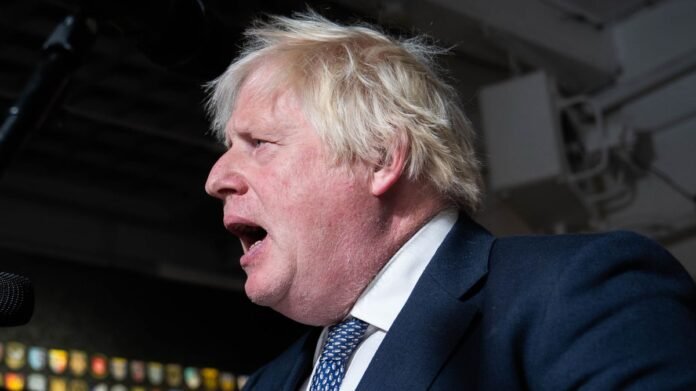

Boris Johnson has strongly criticized Nigel Farage, labeling his stance on Russia as “extremely risky.” The former Conservative Prime Minister expressed significant concerns about Reform UK’s economic and national security approaches, casting doubt on the party’s longevity until the next election.
Regarding Reform UK’s economic and security policies, Johnson emphasized the need for a robust defense under a Conservative government, cautioning against random stances and what he deemed as the dangerous notion that NATO provoked Putin in Ukraine.
Reflecting on Reform UK’s recent polling success, Johnson pointed out the party’s prior insignificance during his tenure as Prime Minister, attributing its rise to the completion of Brexit. He questioned whether the party would endure until the upcoming elections.
Last summer, tensions escalated between Johnson and Farage after the latter suggested that Western actions had provoked the conflict in Ukraine in a BBC Panorama interview. Johnson rebuked Farage for not retracting the statement, denouncing it as Kremlin propaganda and ahistorical drivel.
Johnson’s recent remarks come in the wake of Farage’s reference to a supposed “Boris wave” during Johnson’s term, citing an increase in legal migration. Johnson expressed confidence in Conservative leadership on defense and security issues, endorsing Kemi Badenoch’s vigor and originality among current party leaders.
Addressing concerns about Farage’s stance on the economy and national security, Johnson emphasized the importance of providing serious answers in the face of upcoming challenges, asserting that Conservative solutions would be crucial.
Johnson highlighted the pressing issues of the economy and national security, expressing serious apprehensions about both. He framed the public’s choice as between Labour and Reform UK, cautioning against what he perceived as morally ambiguous views on Russia’s aggression and the invasion of Ukraine.
In the context of global leadership, Johnson underscored the necessity for UK strength and determination, rejecting moral equivocation in the face of transparent evil like the invasion of Ukraine.