

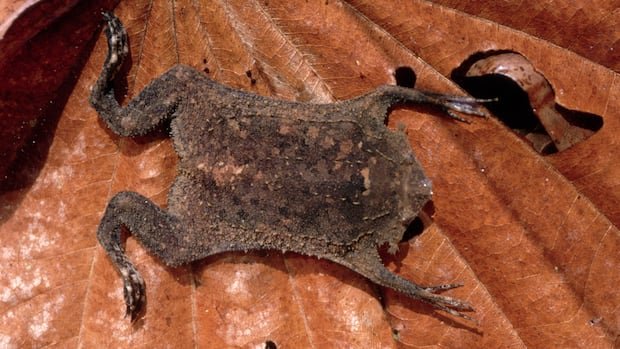

In a remarkable discovery, researchers in California have found that the Surinam toad possesses a unique ability to detect prey using its fingertip lobes. Despite its unusual appearance and limited vision, this flat-bodied amphibian can swiftly capture fish in turbid waters with astonishing speed.
For decades, scientists have been intrigued by the Surinam toad’s hunting prowess. With its distinctive triangular head and tiny eyes, this toad blends seamlessly into the Amazon basin’s murky environment, resembling a lifeless leaf on the riverbed.
A recent study led by Duncan Leitch from the University of California, Los Angeles, unveiled the toad’s remarkable sensory adaptation. The toad, commonly known as the star-fingered toad, uses its uniquely structured fingertips to detect subtle water movements caused by nearby prey.
The research, published in the Journal of Comparative Physiology A, revealed that the toad’s fingertip lobes function as highly sensitive touch organs, akin to the human eye’s fovea. These specialized structures enable the toad to identify the size and proximity of potential prey, allowing it to swiftly capture food without direct contact.
By employing a powerful microscope, Leitch and his team observed that each toad’s fingertips contain 128 specialized lobes with an abundance of touch-sensitive nerves. These sensory-rich areas, comprising only a small fraction of the toad’s skin, play a crucial role in its hunting strategy.
The study’s findings suggest that the Surinam toad’s brain allocates a significant portion of processing power to its fingertips, highlighting an evolutionary strategy similar to that seen in more complex mammalian brains. This unexpected discovery sheds light on how vertebrates, including amphibians, have evolved sophisticated sensory systems to adapt to their environments over millions of years.