

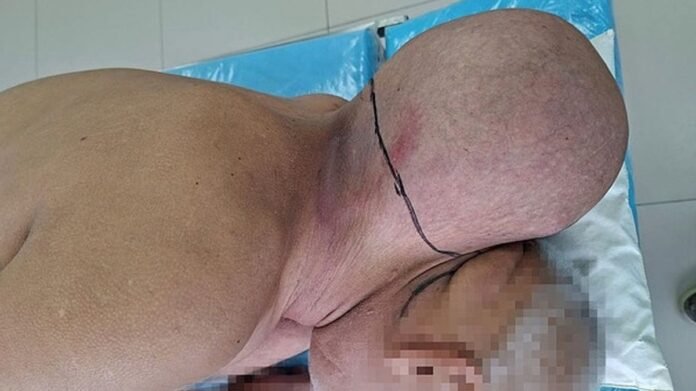

In a striking medical case, a man finally sought treatment at a hospital for a massive tumor in his neck, which he had ignored for nearly two decades believing it would resolve on its own.
The 65-year-old patient arrived at Kirov Regional Clinical Hospital in Russia, stunning doctors with his admission that he had attempted to self-treat the head-sized tumor with ointments instead of seeking professional medical care. Consequently, he endured the burden of the growth for 16 years.
Medical professionals identified the man’s tumor as a lipoma, a benign fatty lump that typically develops between the skin and muscle layers. Lipomas are usually painless and harmless when treated promptly. While common on the back, shoulders, chest, arms, and thighs, lipomas can arise anywhere on the body.
Igor Popyrin, head of the surgical department, explained to a local publication that patients often delay seeking medical help for lipomas due to the slow and painless growth, hoping the tumor will disappear independently. The exact cause of lipomas remains unknown but could be linked to metabolic disorders, genetic factors, or sebaceous gland blockages, leading to delayed hospital visits.
Popyrin emphasized the necessity of surgical removal for lipomas, as they do not regress naturally. Neglecting treatment can result in malignancy or compression of surrounding tissues, underscoring the importance of early intervention.
Surgeons meticulously removed the man’s tumor, which had grown to the size of a 3-liter container, necessitating careful extraction to avoid damage to blood vessels and nerves. Despite the challenges posed by the tumor’s size, the successful operation marked the largest lipoma removal the hospital had ever undertaken.
Notably, a separate case earlier saw a man undergo the removal of a sizable ‘devil’s horn’ from the back of his head after enduring three years of agony. Following the procedure, the patient experienced a newfound sense of relief and freedom from the discomfort caused by the growth.
In conclusion, timely medical intervention remains crucial for addressing benign tumors like lipomas, preventing potential complications and ensuring patients’ well-being.